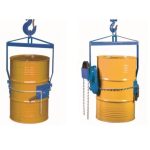



When companies start comparing hydraulic drum trucks, the first thing they often notice is that several models seem almost identical on paper. They may all offer a 250 kg capacity, work with standard 55-gallon steel drums, and use a clamping mechanism to lift and transport drums safely. Because of that, buyers sometimes assume the decision comes down to price alone.
In reality, the difference between these models is not just capacity. The real difference is application.
Three common models in this category are the DT250, DTW250, and DTR250. While they belong to the same family of hydraulic drum handling equipment, they are designed for different working conditions. Choosing the wrong one can slow down handling, create operator frustration, and even make certain drum movements impossible in practice.
This article explains the main differences between these three hydraulic drum trucks and helps you decide which one is best for your warehouse, workshop, or production floor.
What all three models have in common
Before looking at the differences, it helps to understand what these units share.
The DT250, DTW250, and DTR250 hydraulic drum trucks are all designed for handling standard steel drums, especially 55-gallon drums used in industrial environments. In most cases, they offer a rated capacity of 250 kg, making them suitable for lifting, securing, and transporting a full drum over short distances.
They also belong to the same general equipment category: hydraulic drum trucks. That means they are built to let one operator move a drum more safely and efficiently than manual handling would allow. Compared with basic drum dollies or completely manual lifting methods, hydraulic drum trucks improve control and reduce the risk of strain or drum instability.
So if the capacity and basic purpose are similar, what actually separates them?
The answer lies in floor conditions, pallet access, leg structure, and maneuverability.
DT250: the standard choice for drums on the floor
The DT250 is best understood as the standard hydraulic drum truck in this group.
Its biggest advantage is simplicity. It is generally intended for handling drums that are already positioned on the floor, rather than on pallets. If your workflow involves picking up a steel drum from a flat surface, moving it through a workshop or warehouse aisle, and setting it down again, the DT250 is often the most straightforward option.
Because it is a more standard design, it tends to be easier to use in everyday drum transport tasks where pallet access is not required. This makes it a strong choice for:
- general factory drum movement
- production areas with floor-stored drums
- maintenance workshops
- short-distance transfer between stations
In other words, the DT250 is ideal when you do not need the truck to “straddle” a pallet or reach into a palletized storage position.
If your drums mostly sit directly on the ground, this model is usually the most practical and economical solution.
DTR250: better for palletized drums
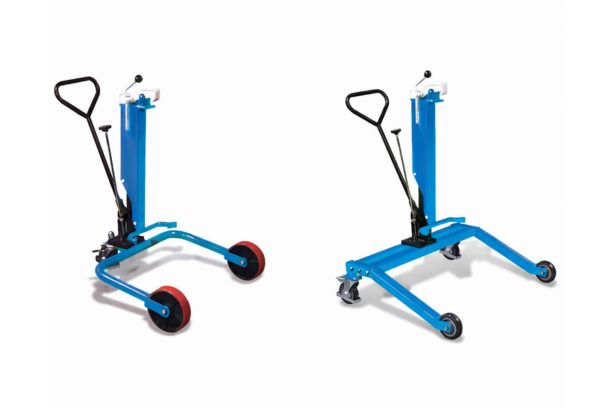
The DTR250 Ride-on Hydraulic Drum Truck is designed for a more specific and demanding task: handling drums that are stored on standard pallets, especially Euro pallets.
This is where many buyers run into trouble. A standard drum truck may work perfectly well for a floor drum, but once the drum is sitting inside a pallet footprint, access becomes more difficult. The truck needs the right geometry to approach the drum, clamp it securely, and lift it without interference from the pallet structure.
That is where the DTR250 stands out.
Compared with the DT250, the DTR250 is better suited for picking up drums from a palletized position. It is commonly described as a pallet-friendly design, and it is often preferred in warehouses where drums are regularly stored or staged on pallets before being moved.
This makes the DTR250 a good choice for:
- warehouses with Euro pallet storage
- shipping and receiving areas
- pallet-based drum handling operations
- facilities where drums are moved between storage and production
Another advantage of the DTR250 is that it generally offers better flexibility in more complex handling environments. If your operators frequently move drums out of storage positions instead of simply rolling them across open floor space, this model is often the better fit.
DTW250: a wide-leg version for greater clearance
The DTW250 Wide leg Hydraulic Drum Truck takes the pallet-handling idea one step further.
The key feature of this model is right in the name: wide-leg design. Its wider leg structure gives the truck more clearance and allows it to work in situations where extra space around the pallet or drum base is necessary.
In practical terms, the DTW250 is also aimed at palletized drum handling, but it offers a broader stance than the standard design. That wider structure can make a big difference when the drum is positioned in a way that requires more clearance, or when pallet dimensions and surrounding obstacles make a narrow or standard configuration less suitable.
This model is often the better option when:
- the pallet layout requires extra leg width
- the operator needs more straddle space
- pallet access is part of the job, but space around the drum varies
- the facility wants more compatibility across different handling conditions
If the DT250 is the standard floor-handling model, and the DTR250 is the pallet-focused model, then the DTW250 can be seen as the wide-leg pallet-handling model.
The real difference: where the drum starts
One of the easiest ways to choose between these three models is to ask a simple question:
Where is the drum usually located before handling begins?
If the answer is on the floor, the DT250 is usually the best match.
If the answer is on a standard pallet, the DTR250 is generally more suitable.
If the answer is on a pallet, but with a need for wider leg clearance or more flexible pallet access, the DTW250 is often the safest choice.
That is the most practical way to think about the comparison. The difference is less about lifting power and more about pickup conditions.
Which model should you choose?
Here is a simple selection guide:
Choose the DT250 hydraulic drum truck if:
- your drums are mostly stored on the floor
- you need a standard hydraulic drum truck for general movement
- your handling route is simple and open
- you want a straightforward solution for steel drum transport
Choose the DTR250 straddle leg hydraulic drum truck if:
- you regularly pick drums from standard pallets
- your warehouse uses palletized storage
- you need better access in loading and unloading operations
- your workflow involves more structured storage positions
Choose the DTW250 wide leg hydraulic drum truck if:
- you need to handle palletized drums with extra leg clearance
- pallet conditions vary
- you want a wider straddle design
- compatibility and access are more important than using the most basic model
Final thoughts
Although the DT250, DTW250, and DTR250 belong to the same 250 kg hydraulic drum truck family, they are not interchangeable in real-world use.
The DT250 is the standard option for drums on the floor.
The DTR250 is better for drums on standard pallets.
The DTW250 is the better fit when pallet handling requires a wider leg design.
For buyers, the smartest approach is not to ask, “Which model is strongest?” but rather, “How are my drums stored before I move them?”
Once that question is clear, the right model usually becomes obvious.
Related Products
 PJ4150 vs. EJ4150 Light Stacker: Manual or Electric for Your Operation?
- LM800N vs LG800 Vertical Drum Lifters: Which One Should You Choose?
- A New Drum Lifting Solution: How the E500 Work Positioner Supports Drum Filling, Transporting and Loading
- ALT Series Buying Guide: Key Parameters to Confirm Before Purchasing a Lift and Tilt Table
- How to Choose the Right Electric Pallet Truck for Your Warehouse
- Manual Stacker vs. Manual Straddle Stacker: When to Choose Which?
- Automatically Walking Electric Lifting Table ES1000E
- Manual Pallet Truck Buying Guide: Capacity, Fork Size, Wheels and Hydraulic System
- 2500kg vs 3000kg Manual Pallet Truck: A Practical Comparison
- How to Choose the Right Manual Stacker