


Choosing the right lift and tilt table is not only about finding a model with enough capacity. In real industrial applications, factors such as platform size, lowered height, tilt angle, load type, and loading method are just as important.
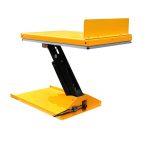
The ALT Series lift and tilt tables is designed to combine lifting and tilting in one mechanism, helping operators work more efficiently while reducing bending, reaching, and repetitive strain. Whether the application involves pallets, bins, containers, or oversized materials, selecting the right model starts with confirming the correct technical parameters.
This guide explains the key points buyers should review before choosing between ALT750, ALT1500, ALT1500UL, ALT1500UM, and ALT1500US.
1. Confirm the Required Load Capacity
The first parameter to verify is the actual working load.
The ALT Series includes two main capacity levels:
- ALT750: 750 kg
- ALT1500 / ALT1500UL / ALT1500UM / ALT1500US: 1500 kg
However, the load does not only include the product itself. Buyers should also consider the total weight of pallets, bins, containers, and any possible variation during operation.
Before selecting a model, confirm:
- total load weight
- whether the load may shift during tilting
- whether future applications may involve heavier loads
- whether a safety margin is required
A model that only matches the exact load may not be the best long-term choice.
2. Check the Platform Size Carefully
For the ALT Series lift and tilt tables material handling equipment, platform size is one of the most critical selection factors.
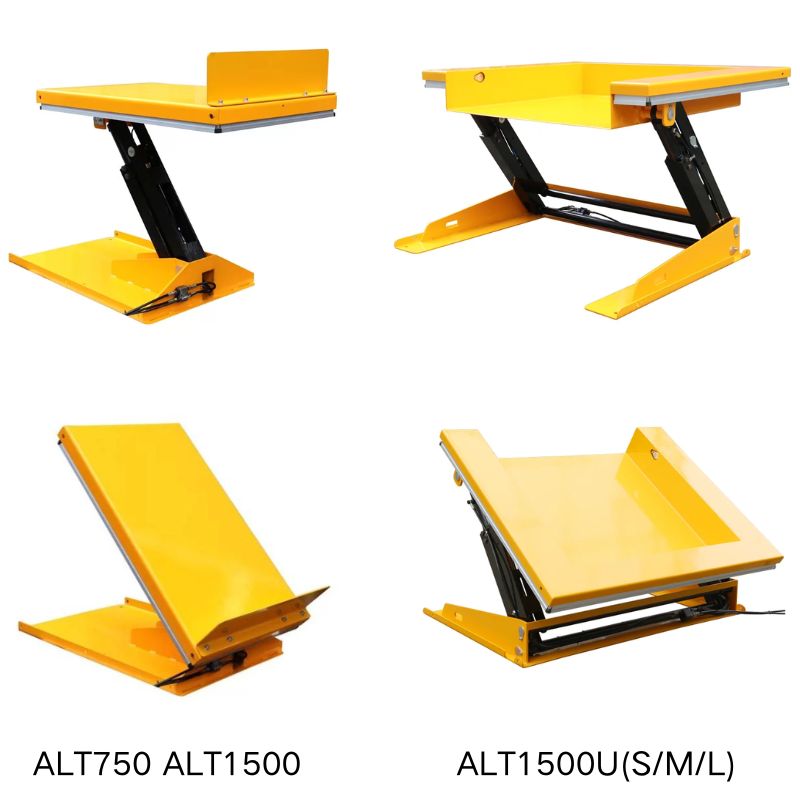
Different models are designed for different load footprints:
- ALT750: 1300 × 800 mm
- ALT1500: 1300 × 800 mm
- ALT1500UL: 1380 × 1730 mm
- ALT1500UM: 1380 × 1510 mm
- ALT1500US: 1380 × 1310 mm
A standard platform may work well for general material handling, while a larger or differently shaped platform may be necessary for oversized loads or specific containers.
Before buying, confirm:
- load length and width
- pallet or container dimensions
- whether the load overhangs the platform
- whether a flat platform or U-shaped platform is more suitable
A wrong platform size can affect both safety and handling efficiency.
3. Confirm the Required Lowered Height
Lowered height directly affects loading convenience.
In the ALT Series, there are two clear configurations:
- ALT750 / ALT1500: 235 mm lowered height
- ALT1500UL / ALT1500UM / ALT1500US: 6 mm lowered height
This difference is important in real working environments.
If the load needs to be placed from floor level, especially by pallet truck, trolley, or manual loading, a low-profile design is usually the better choice. On the other hand, if the load is already positioned on another support or handled by forklift, a standard lowered height may be acceptable.
Buyers should confirm:
- whether loading is done from floor level
- whether pallet trucks or trolleys are used
- whether a pit-free low-profile solution is required
- whether easy ground-level access is a priority
4. Confirm the Required Raised Height
Raised height affects working posture, accessibility, and overall ergonomics.
The ALT Series offers a raised height of 820 mm, which suits many industrial applications. Still, the actual workstation layout should always be reviewed.
Before placing an order, confirm:
- operator working height
- loading and unloading position
- connection to adjacent equipment or production lines
- whether the table must align with another workstation
The right working height helps reduce operator fatigue and improves productivity over time.
5. Check the Tilt Angle Requirement
Tilt is one of the core features of the ALT Series.
All listed ALT models hydraulic lift and tilt tables provide a tilt range of:
- 0 to -45°
This function helps position the load at a more accessible angle, making it easier for operators to remove parts, reach into bins, or handle materials more safely.
Before choosing a model, confirm:
- how much tilt is needed in the actual application
- whether the operator needs better access to deep bins or containers
- whether the load remains stable during tilting
- whether tilt is required as a productivity feature or as an ergonomic necessity
For many buyers, the tilt function is the main reason to choose this type of equipment instead of a standard lift table.
6. Identify the Type of Material Being Handled
The right model depends not only on weight, but also on the shape and nature of the load.
Buyers should clearly define whether they are handling:
- pallets
- bins
- containers
- cartons
- metal parts
- panels
- fabricated components
- oversized or special-size materials
For example:
- ALT1500UL is more suitable for large or special-size materials
- ALT1500UM and ALT1500US are more suitable for low-profile pallet, bin, container, or trolley handling
- ALT750 and ALT1500 are better suited to more standard platform applications
The more clearly the material type is defined, the easier it is to select the correct platform structure.
7. Review Load Distribution and Stability
Capacity alone is not enough. Load distribution also matters.
A load may fall within the rated capacity, but still create problems if it is:
- off-center
- top-heavy
- unstable
- shifting internally during tilt
- taller than usual
This is especially important for larger platforms and tilting applications.
Before purchasing, confirm:
- whether the load is evenly distributed
- whether the center of gravity changes during operation
- whether materials inside containers move during tilt
- whether the load is stable throughout lifting and tilting
This step helps avoid performance and safety issues later.
8. Consider Cycle Frequency and Lift Time
The ALT Series lift time is approximately:
- 18 seconds for ALT750
- 16 seconds for ALT1500 / ALT1500UL / ALT1500UM / ALT1500US
This may be suitable for many applications, but it should still be reviewed against the actual workflow.
Before buying, confirm:
- how many cycles are needed per hour
- whether the table is used occasionally or continuously
- whether speed affects workstation output
- whether the application requires smooth repetitive operation
Cycle expectations should always match real production requirements.
9. Confirm Power Supply Requirements
The ALT Series uses a 0.75 kW power pack, so power compatibility should be checked early in the buying process.
Confirm:
- local voltage requirements
- power phase requirements
- plug or connection type
- control requirements
- indoor or industrial power conditions
This is especially important for export orders and international projects.
10. Check Installation Space and Workflow Layout
Even when the technical parameters look correct, the table must still fit the actual workspace.
Before placing an order, confirm:
- available floor space
- loading direction
- pallet truck or trolley access path
- operator standing position
- tilt clearance
- nearby machines, walls, or safety barriers
This is especially important for:
- ALT1500UL, due to its larger platform
- ALT1500UM / ALT1500US, where floor loading path matters
- compact workstations with limited operating space
A proper layout review helps avoid installation issues after delivery.
11. Verify Safety and Compliance Requirements
Safety should always be part of the selection process.
The ALT Series is described as meeting:
- EN1570
- ANSI/ASME safety standard
Before purchasing, buyers should confirm:
- required compliance for the destination market
- emergency stop requirements
- overload protection
- operator safety protection
- installation safety clearance
- documentation needed for approval or procurement
This point is especially important for European customers and industrial buyers who require technical compliance records.
12. Choose the Right ALT Model for the Application
Here is a simple overview of how the models are generally positioned:
ALT750
Best for standard applications up to 750 kg, such as packaging, assembly, and general material handling.
ALT1500
Best for heavier standard applications up to 1500 kg where a flat platform is still preferred.
ALT1500UL
Best for oversized loads, large bins, and special-size materials requiring a larger platform.
ALT1500UM
Best for low-profile loading applications involving pallets, bins, containers, or trolleys, especially where a wider U-shaped design is useful.
ALT1500US
Best for low-profile loading in tighter spaces where a more compact U-shaped platform is preferred.
Final Checklist Before Sending an Inquiry
Before contacting a supplier, it is best to prepare the following information:
- load weight
- load dimensions
- pallet, bin, or container type
- preferred platform structure
- lowered height requirement
- raised height requirement
- tilt angle requirement
- expected cycles per hour
- voltage and power supply
- installation layout
- destination market
The clearer the information, the faster the correct model can be recommended.
Conclusion
Selecting the right ALT Series lift and tilt table requires more than checking capacity alone. Buyers should also confirm platform size, lowered height, raised height, tilt angle, load type, loading method, and installation layout before making a decision.
A proper review of these parameters helps ensure the equipment fits the application, improves ergonomics, and supports efficient material handling over the long term.
Need help choosing the right ALT model? Send us your load weight, load size, and application details, and we will recommend the most suitable solution.
Related Products
 Does a 300kg Application Really Need a 1000kg Rotating Lift Table?
- Manual Pallet Truck Buying Guide: Capacity, Fork Size, Wheels and Hydraulic System
- DT250 vs. DTW250 vs. DTR250: How to Choose the Right Hydraulic Drum Truck
- PJ4150 vs. EJ4150 Light Stacker: Manual or Electric for Your Operation?
- 2500kg vs 3000kg Manual Pallet Truck: A Practical Comparison
- Tilter Table Small Platform ALT750
- LM800N vs LG800 Vertical Drum Lifters: Which One Should You Choose?
- How Buyers Can Choose the Right Forklift Fork Extensions
- HRL Rotating Lift Table vs. ERP2000 Stretch Wrap Machine: How to Choose the Right Solution for Your Pallet Handling Application
- HS Manual Stacker vs QES Electric Stacker: Which Pallet Stacker Is Right for Your Warehouse?