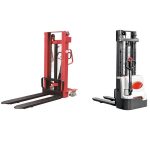



When choosing a light stacker, most buyers are not asking which model looks better on paper. They are asking which one fits their real operation better. That is exactly the question behind the comparison between the PJ4150 light stacker and the EJ4150 electric light stacker.
Both models are designed for compact working areas. Both are suitable for lifting, transporting, and positioning light loads. Both can also be used with an optional platform, which means they can do more than standard pallet handling. But the biggest difference is simple: the PJ4150 is manual, while the EJ4150 is electric. That single difference affects labor, workflow, operator comfort, and overall equipment choice.
What the Two Models Have in Common
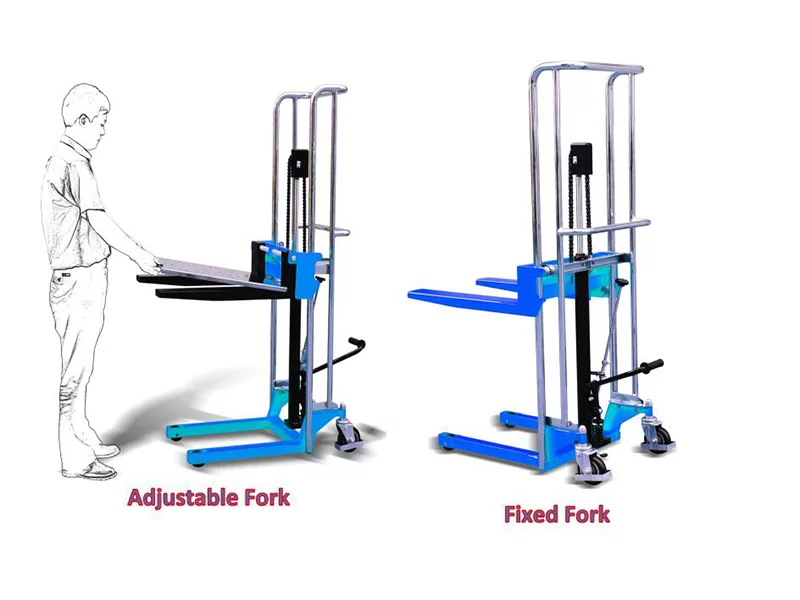
The PJ4150 and EJ4150 are built for narrow spaces where a larger stacker may be unnecessary or difficult to use. In the 4150 versions, both offer a 400 kg / 880 lb capacity and a maximum lift height of 1500 mm / 60 in. Both have a minimum fork height of 85 mm, a fork length of 650 mm, and a compact overall width of 570 mm, making them practical for confined work areas.
Another important similarity is versatility. Both models can be used with an optional platform attachment, allowing them to handle cartons, bins, office equipment, and other non-palletized loads. That makes them useful not only as stackers, but also as compact work positioners for packing, sorting, assembly, and general material handling.
Why the PJ4150 Light Stacker Makes Sense
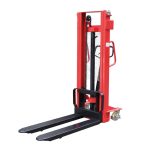
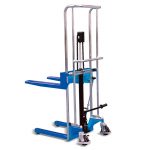
The PJ4150 is a manual light stacker designed for users who want a simple, compact, and reliable lifting solution. It uses a foot-operated hydraulic pump and controlled manual descent. The adjustable-fork version offers a fork width range of 210–550 mm, which gives it flexibility for handling different load types. It also uses polyurethane swivel casters with brakes and phenolic load wheels for smooth movement and floor protection.
For many buyers, the biggest advantage of the PJ4150 is simplicity. There is no battery to charge, no motor to manage, and fewer components to maintain. That makes it a strong choice for businesses that want dependable performance with lower equipment complexity.
The PJ4150 light stacker is especially well suited to operations where lifting is regular but not constant. Offices, workshops, mailrooms, stock rooms, packing stations, and smaller warehouses are all good examples. If the equipment is used several times a day but not in heavy repetitive cycles, a manual solution often makes the most practical sense.
It is also a good choice for buyers who want lower upfront cost and straightforward operation. For companies that value ease of ownership and mechanical simplicity, the PJ4150 offers a strong balance between performance and affordability.
Why the EJ4150 Light Stacker Makes Sense
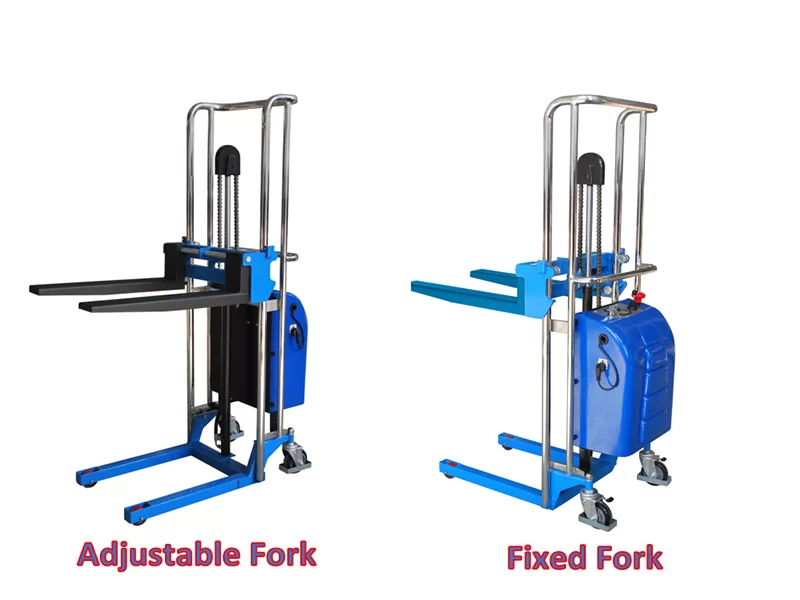
The EJ4150 light stacker is the electric version for buyers who need the same compact format but with less manual effort. It features electric lifting and lowering, powered by a 0.8 kW motor and a 12V / 70Ah battery. The adjustable-fork version has a fork width range of 215–500 mm and is designed for one-person operation in tight working environments.
The key benefit of the EJ4150 is improved efficiency in repeated lifting tasks. If operators are constantly raising and lowering loads throughout the day, manual pumping can slow the job down and increase fatigue. Electric lifting reduces that effort and helps create a smoother workflow.
That is why the EJ4150 work platform light stacker is often the better fit for busier environments such as warehouses, hospitals, retail back rooms, factories, and laboratories. In these settings, loads may not be extremely heavy, but the lifting cycle is frequent enough that powered lift becomes a real advantage.
In practical terms, the EJ4150 is a better option when operator comfort, labor savings, and productivity matter more than keeping the equipment as simple as possible. Buyers who want a more ergonomic solution without moving to a much larger electric stacker will often find the EJ4150 a very good fit.
Manual or Electric: How to Decide
The easiest way to choose between these two models is to focus on your daily workflow.
If your team only lifts and positions loads occasionally or at a moderate pace, the PJ4150 is usually the more sensible choice. It gives you the height, capacity, flexibility, and compact design you need without adding an electric system.
If your team handles loads repeatedly throughout the day, the EJ4150 is likely the better investment. The electric lift system reduces operator effort and can improve daily efficiency in repetitive handling work.
Another difference is weight. The adjustable-fork PJ4150R weighs about 85 kg, while the adjustable-fork EJ4150R weighs about 127 kg. The added weight of the EJ4150 reflects its motor and battery system. Buyers who want the lightest and simplest model may prefer the PJ4150, while those focused on reducing repetitive manual work are more likely to choose the EJ4150.
Final Thoughts
The PJ4150 and EJ4150 are both practical light stackers for compact material handling. They are designed for similar applications, but they serve different priorities.
The PJ4150 is the better choice for buyers who want a manual light stacker that is compact, flexible, economical, and easy to maintain. It works well in light-to-moderate duty applications where simple operation matters.
The EJ4150 is the better choice for buyers who want an electric light stacker that reduces manual effort and supports more efficient repetitive lifting. It is a stronger fit for operations where workflow and operator comfort carry more weight.
In the end, the right choice is not about manual versus electric in general. It is about which model better matches your workspace, lifting frequency, and day-to-day operation.
Looking for the right light stacker for your application? Whether you need the simplicity of the PJ4150 or the labor-saving performance of the EJ4150, our team can help you choose the best model based on your load type, lifting height, and working environment.
Related Products
 DT250 vs. DTW250 vs. DTR250: How to Choose the Right Hydraulic Drum Truck
- Manual Stacker vs. Manual Straddle Stacker: When to Choose Which?
- HS Manual Stacker vs QES Electric Stacker: Which Pallet Stacker Is Right for Your Warehouse?
- How to Choose the Right Manual Stacker
- ALT Series Buying Guide: Key Parameters to Confirm Before Purchasing a Lift and Tilt Table
- FEYG Full electric self-propelled Lifter
- LM800N vs LG800 Vertical Drum Lifters: Which One Should You Choose?
- SSS25L Single Sensor Scale Pallet Truck Load Indicator
- Advantages of Self-Loading Electric Stackers in Factory Operations
- How to Move a 10-Ton Heavy Load Safely: Choosing the Right Rotating Roller Machine Skates