


Loading and unloading a semi-trailer or container trailer sounds routine—until the tractor drives away and the trailer’s front end becomes vulnerable. A forklift entering (or leaving) a disconnected trailer can shift the center of gravity fast, increasing the risk of up-ending (a sudden nose lift or tip), especially on uneven ground or when landing gear is worn.
This is exactly why OSHA notes that fixed jacks may be necessary to support a semitrailer and prevent upending during loading or unloading when it’s not coupled to a tractor, and it also emphasizes using brakes and wheel blocks to prevent movement.
In this guide, we’ll compare two common support solutions used in yards, docks, and container operations:
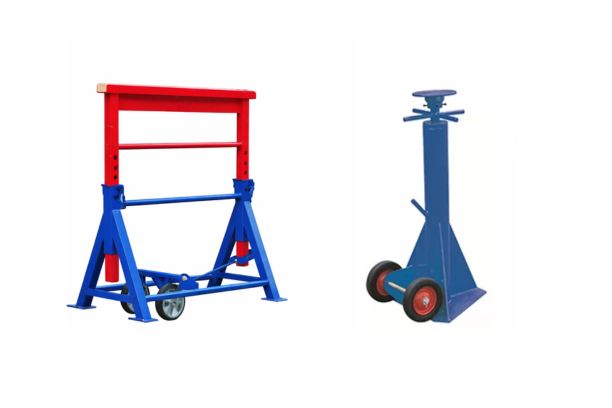
Trailer Trestle — a long-contact, heavy-duty “trestle-style” support designed to keep trailers stable and level, including on sloping ground.
Trailer Stabilizer Jack — a classic dock-safety stabilizing jack designed to prevent up-ending during loading/unloading, with OSHA-focused positioning and usage practices (when used with wheel chocks).
Below, we’ll break down how to choose the safest option for semi-trailers, container trailers, and heavy loading scenarios.
1) What makes a trailer “unsafe” during loading?
When a trailer is not connected to a tractor, the front end can behave like a lever. Forklift entry, pallet placement, and shifting loads can create upward or sideways forces—especially if:
The ground is uneven or sloped
The landing gear sinks into soft surfaces
The landing gear is damaged, worn, or not properly deployed
The loading pattern puts excessive weight toward the rear before the front is supported
OSHA’s guidance doesn’t mandate one universal jack type or exact quantity, and an OSHA interpretation letter explains that the standard doesn’t specify “the number and placement” of portable jacks—OSHA strongly recommends following the trailer manufacturer and jack manufacturer instructions for correct number and placement.
That means the “right” solution is the one that best matches your trailer type, surface conditions, and loading method, while following manufacturer instructions and site safety rules.
2) Quick definitions: Trailer Trestle vs. Trailer Stabilizer Jack
Trailer Trestle
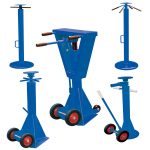
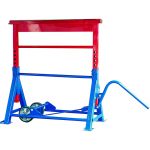
A Trailer Trestle is described as a heavy-duty support jack used to keep a trailer stable and level when disconnected from the tractor or parked on sloping ground, with 5 height adjustment positions (50 mm per step) and a two-wheel design for easier handling.
Key JK15 specs that matter in real operations:
Capacity: 15,000 kg (33,000 lb)
Min/Max lifting height: 1070–1270 mm (42–50 in)
Support length: 1200 mm (47.2 in) — long contact area
Mobility: two wheels; designed to be easy to move and handle
Where it shines: heavier trailers and container-related setups where a long support/contact length improves stability, and where leveling on slopes is a recurring need.
Trailer Stabilizer Jack
The Trailer Stabilizer Jack is described as being used to prevent up-ending of semi-trailers when they are not connected to a tractor during loading/unloading, and also to level trailers on sloped ground and prevent landing gear from sinking into soft surfaces. The page also notes it meets OSHA regulations when used with wheel chocks.
Key TJ40 specs for safety and planning:
Service range: 1000–1300 mm (40–51 in)
Static capacity: 45,000 kg (100,000 lb)
Lifting capacity: 18,000 kg (40,000 lb)
Design cues: ACME threaded screw, reflective collar, safety yellow finish (visibility & durability features common in dock-safety jacks)
Where it shines: loading docks and freight yards where the main risk is up-ending during forklift loading/unloading, especially when the tractor is detached.
3) The practical differences that influence your choice
A) Stability approach: long contact vs. corner support
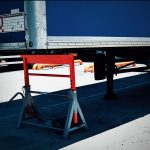
Trailer Trestle (JK15) uses a long support length (1200 mm), which can distribute contact along a wider section of the trailer underside. This style is often preferred when you want a “trestle-like” support footprint for heavy trailer stability and leveling.
Stabilizer Jacks (TJ40) are typically positioned near the front corners of the trailer to prevent up-ending and reduce tipping risk during loading/unloading—especially important for side-tipping dynamics.
Competitor guidance reinforces this corner-support concept: for example, Vestil explains it is “always recommended to use two jacks, one on each side of the front of the trailer” during loading/unloading when the trailer is not connected to a tractor.
SafeRack similarly states: “ALWAYS use two jacks at the front of each trailer… A single jack in the center will not prevent side-tipping.”
Takeaway:
If your main concern is side-tipping during loading/unloading, a pair of stabilizer jacks placed near the front corners is the most commonly recommended approach in the market.
B) Load capacity: what “capacity” actually means in use
It’s tempting to compare numbers directly, but note that jack capacity is typically given as static capacity (holding load) and sometimes lifting capacity (raising load).
JK15 lists 15,000 kg capacity.
TJ40 lists 45,000 kg static capacity and 18,000 kg lifting capacity.
Competitors show a similar pattern: many dock stabilizer jacks advertise high static capacities (often up to 100,000 lb) because the job is primarily to support, not to “lift like a service jack.”
Takeaway:
For stabilizing a disconnected trailer during loading/unloading, prioritize proper placement, firm ground, and using the correct number of supports at the front—then ensure the jack’s capacity and range match your trailer geometry and site conditions. OSHA also ties stability to broader controls like wheel chocks and preventing vehicle movement.
C) Ground conditions: slopes and soft surfaces
Both product types can be used on sloped ground in the right setup:
JK15 explicitly highlights keeping the trailer level on sloping ground, with multi-step height adjustment.
TJ40 is described as useful for leveling on slopes and preventing landing gear from sinking into soft surfaces.
Takeaway:
If soft ground or uneven yard conditions are common, choose a solution that matches your surface realities—and ensure crews are trained to position supports on firm, stable ground (or use proper base support where required).
4) How many supports do you need?
This is the question buyers actually care about.
Common industry recommendation: two stabilizer jacks at the front
Multiple competitors recommend two jacks, one at each front corner, during loading/unloading when uncoupled. Vestil recommends two jacks (one on each side). SafeRack explicitly warns against a single center jack because it won’t prevent side tipping.
What about using “one” Trailer Trestle?
A trestle-style support with a long contact area (like JK15’s 1200 mm support length) can feel more stable in certain setups. However, because OSHA does not prescribe a universal number/placement and advises following manufacturer instructions, you should treat “one vs. two” as a site-specific decision based on your trailer geometry, load activity, and risk controls.
Practical rule of thumb for writing your blog (safe wording):
For loading/unloading safety at a dock: strongly consider two stabilizer jacks at the front corners, plus wheel chocks/positive protection.
For leveling/stability needs (especially heavy trailers/containers, sloped yards): a trestle-style support may be a good fit, but final quantity/placement should follow manufacturer guidance and your safety procedures.
5) A simple selection checklist (use this in your conclusion/CTA)
Choose a Trailer Stabilizer Jack (like TJ40) if:
Your top risk is up-ending during loading/unloading with the tractor disconnected
You want an OSHA-aligned, dock-safety style solution (with wheel chocks)
You plan to use two jacks at the front as commonly recommended by manufacturers in the market
Choose a Trailer Trestle (like JK15) if:
You need to keep heavy trailers stable and level, including on sloping ground
A long support length (1200 mm) and multi-step height adjustment fit your trailer underside contact and yard workflow
Mobility matters (two-wheel design for easier handling)
Final thoughts: safety is a system, not a product
The safest choice is the one that fits your operation: your trailer types (semi-trailers, container trailers), your surfaces (dock apron vs. yard), and your loading patterns. OSHA’s language makes the goal clear—prevent upending—and also highlights other essential controls like wheel blocks and preventing vehicle movement during loading/unloading.
If you’re deciding between a Trailer Trestle and a Trailer Stabilizer Jack, start with this question:
Are you mainly trying to (1) stabilize and level a heavy trailer on challenging ground—or (2) prevent up-ending during active forklift loading/unloading?
Answer that, and the product choice becomes much easier.
Need help matching capacity, service range, and recommended setup for your trailer types? Use the product spec sheets as your baseline and align your purchase with your site safety procedure and manufacturer guidance.
Related Products
 TJ40 Trailer Stabilizer Jack
- JK15 Heavy-duty Stabilising Jack Trailer Trestle
- Safety Swing Gate vs Mezzanine Gate: What’s the Difference and Which One Should You Choose?
- JK15 Heavy-Duty Stabilising Jack: The Ultimate Solution for Safe Trailer Parking | i-lift Europe Stock
- 5 Common Mistakes Buyers Make When Selecting Rotating Roller Machine Skates
- Why Hydraulic Toe Jacks Have Two Capacities (Toe vs Head)
- Does a Stationary Lift Table Need a Pit? Installation Methods Explained
- What to Consider When Buying a Hand Hydraulic Pallet Truck
- SM1000 electric mini tow tractor
- Redefining Logistics Efficiency: How iLift Professional Jacks Transform Your Material Handling