


If your team regularly picks, packs, sorts, or assembles items from pallets on the floor, you’ve probably seen the same problem every day: constant bending. It’s slow, tiring, and (over time) a recipe for back and shoulder strain. The good news is that you don’t have to choose between “manual handling” and “buying a forklift.”
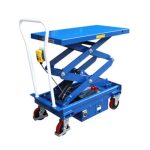
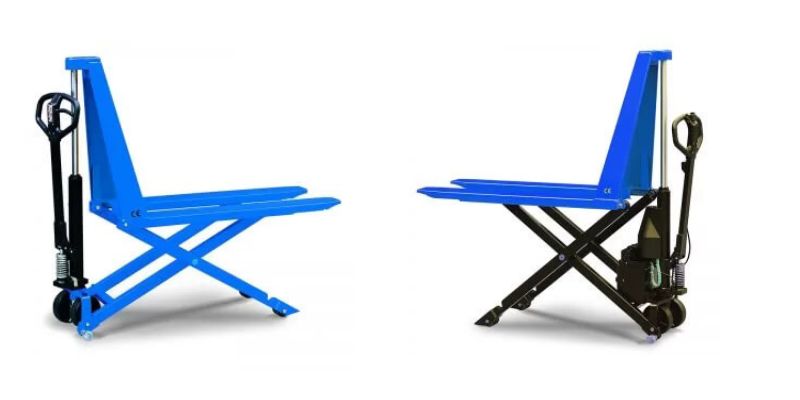
A practical, warehouse-friendly solution is a high lift scissor truck (also called a high lift pallet truck or scissor lift pallet jack): it lifts the whole pallet up to a comfortable working height, so operators can handle cartons at waist level instead of on the floor.
Why bending over pallets feels “normal” (but costs you more than you think)
Floor-level pallet work forces workers to repeatedly:
- bend at the waist to grab cartons,
- twist while repositioning loads,
- reach forward to the center of a pallet.
Competitor guides often highlight the same pain point: repetitive bending is closely linked with workplace strain and reduced productivity, and the simplest fix is to raise the pallet to a safe working height.
When you raise the pallet, two things happen immediately:
- Handling becomes faster(less “down-up-down-up” movement).
- Work becomes more consistent(less fatigue, fewer pauses).
The “best way” to stop bending: lift the pallet, not the person
Many teams try step stools, low tables, or improvised platforms. Those “fixes” often create new risks: unstable footing, awkward pallet access, or blocked aisles.
A high lift scissor truck is built specifically to solve this job:
- It moves pallets like a standard pallet truck
- Then lifts the pallet vertically using a scissor mechanism to an ergonomic height for picking, packing, or assembly
Typical max lift height for high-lift models is around 800 mm (32 inches)—right in the range most warehouses consider “workbench height.”
Where a high lift scissor truck delivers the biggest impact
Based on how these units are positioned across the market, here are the highest-ROI use cases:
1) Order picking & packing from pallets
Raise the pallet so cartons stay near waist height during picking. This helps reduce repetitive bending and can improve picking rhythm.
2) Assembly and kitting lines
A high lift pallet truck can act as a mobile workstation, bringing parts to the line at the right height.
3) Loading/unloading in tight areas
When a forklift isn’t ideal (space, cost, or traffic), a scissor lift pallet jack can handle many “lift-and-position” tasks more simply.
What to look for when choosing a high lift scissor truck
To avoid buying the wrong unit, focus on these practical checks:
Lift height & stability
- If you’re lifting to ~800 mm, ensure the truck has stabilizers/leg supports for safe elevated work.
Capacity that matches real loads
- Common capacities are 1000 kg and 1500 kgin many high-lift scissor trucks.
Pallet compatibility
- Many high-lift designs are intended for open-bottom pallets; closed-bottom pallets may not always be suitable depending on the design.
Manual vs electric lift
- Manual is simple and cost-effective.
- Electric lift reduces effort when lifting frequently, especially in picking/assembly workflows.
Recommended solution: i-lift HB High Lift Scissor Truck (manual & electric options)
If your main issue is “bending over pallets is too exhausting,” the i-lift HB high lift scissor truck series is designed for exactly that workflow—lifting pallets to 32 inches (800 mm) so operators can handle goods at a more ergonomic height.
Key product advantages (practical, job-site focused)
- Max fork height: 800 mm (32")for waist-level work
- 1000 kg / 1500 kg capacity options, with multiple models and fork widths
- Automatic stabilizers above 400 mm to improve stability while working at height
- Single-stage cylinder design(aimed at consistent performance and reduced risk compared with multi-stage concepts)
- Manual models with quick-lift function(faster lifting for light loads under 250 kg)
- Electric lift models(including versions with built-in charger) for frequent lifting cycles
- Designed for open bottom pallets(and notes that closed bottom pallets can be placed directly on the forks)
- Notes compliance references such as EN1757-4 and EN1175(useful for many buyers’ internal safety documentation)
In day-to-day operations, that combination means one piece of equipment can:
- transport a pallet,
- lift it to working height,
- and serve as a compact “work platform” during picking, packing, or assembly.
FAQ
How high should I lift a pallet to reduce bending?
Many warehouses target a “comfortable working height” around waist level. High-lift pallet trucks commonly lift in the ~800 mm / 32 inch range.
Can I still move the pallet when it’s raised?
Most high-lift scissor pallet trucks are designed to be moved like a pallet truck at low height, then used more like a workstation when elevated—often with stabilizing supports for safety at higher lift.
Bottom line
If your team is losing time and energy to constant bending at pallets, a high lift scissor truck is one of the simplest upgrades you can make—without changing your entire material-handling setup. For a proven, export-ready option with both manual and electric models, the i-lift HB high lift scissor truck line is built to lift pallets to a safer working height and reduce the strain of floor-level handling.
Related Products
 When Do You Need a U-Shape Low Profile Stationary Lift Table?
- Safety Swing Gate vs Mezzanine Gate: What’s the Difference and Which One Should You Choose?
- Factors to Consider When Selecting a Work Positioner
- Does a Stationary Lift Table Need a Pit? Installation Methods Explained
- Where Can a Pallet Turntable Be Used in Material Handling?
- What to Consider When Buying a Hand Hydraulic Pallet Truck
- Manual Pallet Truck Buying Guide: Capacity, Fork Size, Wheels and Hydraulic System
- Electric Lift Table Cart Buying Guide: What to Consider Before You Buy
- A Comprehensive Guide to iLift’s Full Range of Pallet Handling Equipment
- Rotate, Lift, and Work Smarter: A Deep Dive into the Powerful Features of the i-Lift Rotating Lift Table