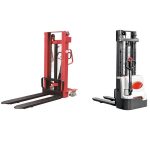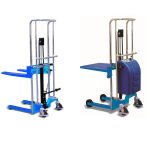



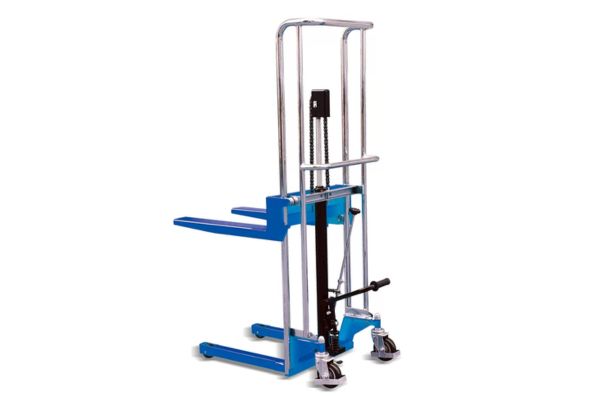
A manual stacker is a practical solution for lifting and positioning goods that are too heavy to handle safely by hand but do not require a forklift or fully powered stacker.
Manual stackers are commonly used in warehouses, workshops, production areas, offices, stockrooms and mailrooms. They can lift cartons, components, tools, containers, office equipment and suitable palletized loads.
However, selecting the right model requires more than checking the rated capacity. Buyers should also consider lift height, load dimensions, fork or platform requirements, available working space and daily operating frequency.
This guide explains the main factors to evaluate before purchasing a manual stacker.
1. Confirm the Maximum Load Weight
Load capacity should be the first consideration.
The total load includes the product, pallet, container, tray, fixture and any accessory placed on the stacker. Always choose a model according to the heaviest expected load rather than the average load.
The i-lift light manual stacker range includes models with capacities of 200 and 400 kg.
A 200 kg model may be suitable for:
- Office supplies and files
- Light cartons
- Computer equipment
- Small components
- Packaging materials
A 400 kg model may be more suitable for:
- Machine parts
- Motors and pumps
- Workshop tools
- Loaded containers
- Production fixtures
Never exceed the rated capacity. An oversized or poorly balanced load may also be unsafe even when its total weight is below the maximum rating.
2. Select the Correct Lift Height
Measure the height of the surface where the load will be placed.
This could be a workbench, packing table, machine loading point, shelf or production fixture. The stacker should raise the bottom of the load slightly above the receiving surface.
The i-lift manual light stacker range offers maximum fork heights of 850, 1200 and 1500 mm.
850 mm
Suitable for low workbenches, machine-side positioning and basic load transfer.
1200 mm
A flexible choice for general warehouse, workshop, packing and assembly applications.
1500 mm
Suitable for higher work surfaces, shelving and production equipment.
When choosing a taller model, also check the overall mast height against doorways, elevators, ceilings and vehicle cargo areas.
3. Identify the Load Type
Different loads require different supporting methods.
Before ordering, confirm the load’s:
- Weight
- Length and width
- Base structure
- Center of gravity
- Stability
- Fork-entry openings
Palletized Loads
If pallets will be handled, check the pallet width, entry direction, opening height, bottom boards and required fork spacing.
Not every manual stacker is compatible with every pallet. The stacker forks and supporting legs must be able to enter the pallet correctly.
Cartons and Flat-Bottomed Loads
Boxes, office equipment and components without fork openings may require a platform.
The i-lift light stacker can be fitted with an optional platform, allowing it to operate as a compact work positioner. Available platform sizes include 650 × 530 mm and 660 × 580 mm.
The load should fit securely on the platform without excessive overhang.
4. Choose the Appropriate Fork Configuration
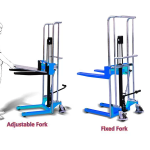
Adjustable forks are useful when different load widths or supporting points are involved.
They may be suitable when:
- Load dimensions frequently change
- Several departments share the stacker
- Different containers are handled
- The platform is regularly removed
Fixed forks may be sufficient when:
- Load dimensions are standardized
- The same task is repeated
- The platform remains installed
- The stacker is dedicated to one workstation
The i-lift PJ series uses adjustable forks, while the PF series uses fixed forks. The adjustable fork range is approximately 210–550 mm, while the fixed fork width is 550 mm.
5. Measure the Working Area
A compact stacker still requires enough space for turning, positioning and safe operator movement.
Measure:
- Door widths
- Aisle widths
- Turning areas
- Elevator dimensions
- Ceiling clearance
- Space around machines
- Storage areas
The i-lift manual light stacker has an overall width of approximately 570 mm and an overall length of around 1100 mm.
Remember that the load itself may be wider than the stacker. Always evaluate the equipment with the largest expected load attached.
6. Consider Daily Operating Frequency
Manual stackers are best suited to low- or moderate-frequency lifting over short distances.
Choose a manual stacker when:
- Lifting is occasional
- Travel distances are short
- Simple maintenance is preferred
- Charging facilities are unavailable
- Purchase cost is an important consideration
An electric-lift stacker may be more suitable when:
- Loads are raised frequently
- The equipment is used throughout the day
- Loads regularly approach maximum capacity
- Reducing operator effort is important
- Higher productivity is required
The cheapest model is not always the most economical choice. Operating frequency and labor requirements should also be considered.
7. Check the Pump and Lowering Controls
The control system affects operating convenience and load positioning.
The i-lift manual light stacker uses a foot-operated hydraulic pump. This can be useful in confined spaces where there is not enough room to operate a large pumping handle.
A manually controlled release valve allows the forks or platform to be lowered gradually.
Operators should always become familiar with the controls before handling a load and should never lower goods suddenly.
8. Evaluate Wheels and Floor Conditions
Manual stackers perform best on firm, clean and level indoor floors.
Check the route for:
- Uneven surfaces
- Door thresholds
- Floor gaps
- Drainage channels
- Debris
- Slopes
- Wet or oily areas
The i-lift light stacker uses polyurethane swivel steering wheels with brakes and rigid front load wheels.
The brakes should be applied before lifting, lowering or transferring a load. However, wheel brakes do not make operation on slopes safe.
9. Review Construction and Maintenance
A manual stacker should be inspected regularly.
Important components include:
- Forks
- Platform
- Mast
- Chain
- Hydraulic cylinder
- Wheels
- Brakes
- Lowering valve
- Fasteners
The i-lift light stacker features powder-coated steel construction, chrome-plated rails, steel guide wheels and a chain cover.
Do not operate the equipment if there is hydraulic leakage, structural damage, unusual wheel movement or a problem with the lowering control.
Manual Stacker Selection Checklist
Before requesting a quotation, provide the following details:
- Maximum total load weight
- Load length, width and height
- Required lift height
- Pallet or container type
- Fork or platform requirement
- Narrowest doorway or aisle
- Floor condition
- Daily lifting frequency
- Travel distance
- Manual or electric lifting preference
Frequently Asked Questions
What capacity should I choose?
Choose a capacity equal to or greater than the heaviest total load, including its container, pallet or fixture.
Can a manual stacker handle pallets?
Yes, but pallet dimensions and bottom construction must match the forks and supporting legs.
Can it handle boxes?
Yes. A platform-equipped model can support stable, flat-bottomed cartons and equipment.
When should I choose an electric stacker?
Consider electric lifting when the equipment is used frequently or when reducing operator effort is a priority.
Conclusion
Choosing the right manual stacker starts with understanding the load and the working environment.
Confirm the maximum weight, required lift height, load dimensions, fork or platform requirements and available maneuvering space. Daily operating frequency and floor conditions should also be considered.
The i-lift manual light stacker range offers 200 and 400 kg capacities, lift heights from 850 to 1500 mm, compact dimensions, foot-operated hydraulic lifting and optional platforms.
Providing complete application details will help i-lift recommend the most suitable model for your warehouse, workshop, office or production area.
Related Products
 Manual Pallet Truck Buying Guide: Capacity, Fork Size, Wheels and Hydraulic System
- How to Choose the Right Electric Pallet Truck for Your Warehouse
- 2500kg vs 3000kg Manual Pallet Truck: A Practical Comparison
- Optimizing Warehouse Efficiency: A Data-Driven Guide to Manual vs. Electric Pallet Trucks
- HS Manual Stacker vs QES Electric Stacker: Which Pallet Stacker Is Right for Your Warehouse?
- PJ4150 vs. EJ4150 Light Stacker: Manual or Electric for Your Operation?
- How Portable Stack Racks Help Prevent Product Crushing in Storage
- How to Choose a Fixed Lift Platform for Outdoor Applications: Key Factors to Consider
- Safety Swing Gate vs Mezzanine Gate: What’s the Difference and Which One Should You Choose?
- PJ4150 Light Stacker: The Ultimate Manual Stacking Solution for Efficient Workspaces