


In warehouses, factories, and distribution centers, fall protection and access control are critical components of workplace safety. One common question facility managers and safety officers often ask is:
Should I use a Safety Swing Gate or a Mezzanine Gate?
Although both products are designed to improve safety at elevated or restricted areas, they serve very different purposes. Choosing the wrong type of gate can lead to compliance issues, safety risks, and unnecessary costs.
This guide breaks down the key differences between a Safety Swing Gate and a Mezzanine Gate, explains where each one works best, and helps you choose the right solution for your facility.
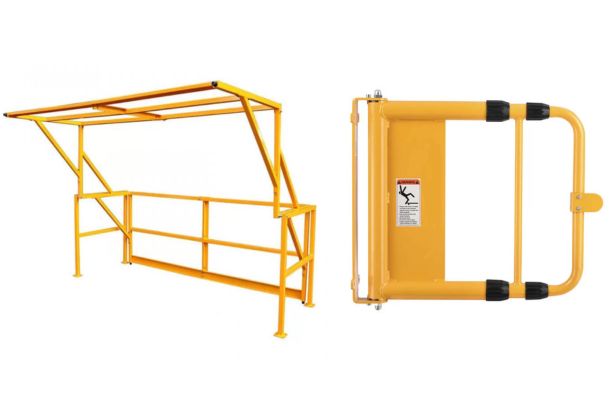
What Is a Safety Swing Gate?
Key Characteristics of a Safety Swing Gate
Spring-loaded, self-closing mechanism
Automatically returns to the closed position after useLightweight but durable steel construction
Installs directly onto guardrails or handrails
Designed primarily for pedestrian use
Simple, cost-effective safety solution
Common Applications
Safety swing gates are commonly used in:
Platform and mezzanine walkways
Stairway openings
Equipment access points
Elevated work areas where people, not materials, pass through
Primary Purpose
The main function of a safety swing gate is access control and fall prevention for personnel. It ensures that an opening is not left unprotected when someone passes through.
Important:
When a swing gate is open, the opening is temporarily unguarded. For this reason, safety swing gates are not ideal for pallet loading or material handling areas.
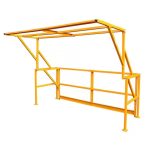
What Is a Mezzanine Gate?
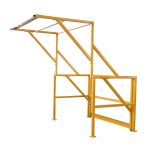
Key Characteristics of a Mezzanine Gate
Dual-gate or pivoting design
Ensures one side is always closed
Heavy-duty steel construction
Designed for pallet and forklift operations
Integrated toe boards and guardrails
Common Applications
Mezzanine gates are typically used in:
Warehouse mezzanine loading zones
Elevated pallet drop areas
Forklift loading/unloading points
Industrial platforms handling heavy materials
Primary Purpose
The defining feature of a mezzanine gate is continuous fall protection.
Even during pallet transfer, one barrier always remains in place, protecting workers from falls.
This design makes mezzanine gates ideal for OSHA-compliant material handling operations.
Safety Swing Gate vs Mezzanine Gate: Key Differences
| Feature | Safety Swing Gate | Mezzanine Gate |
|---|---|---|
| Primary Use | Pedestrian access control | Pallet & material handling |
| Closing Mechanism | Spring-loaded, self-closing | Counterbalanced or pivoting |
| Continuous Protection | ❌ No | ✅ Yes |
| Typical Load Area | Walkways, stairs | Forklift & pallet zones |
| Installation Complexity | Simple | Moderate |
| Cost Level | Lower | Higher |
| Best For | People movement | Material transfer safety |
Which Gate Is Right for Your Facility?
Choose a Safety Swing Gate If:
The opening is used only by personnel
You need a simple, self-closing barrier
The goal is to prevent accidental falls or unauthorized access
Budget and quick installation are important
There is no forklift or pallet traffic
Typical example:
A maintenance walkway on a mezzanine where employees occasionally pass through.
Choose a Mezzanine Gate If:
Pallets or materials are transferred at height
Forklifts or pallet jacks are involved
You need continuous edge protection
OSHA or internal safety audits are a concern
Worker fall risk must be minimized during loading
Typical example:
A warehouse mezzanine where pallets are lifted to the upper level.
Common Mistakes When Choosing a Safety Gate
❌ Using a Safety Swing Gate at a Pallet Loading Area
This is one of the most common and dangerous mistakes. A swing gate leaves the edge exposed when open, creating a serious fall hazard.
❌ Underestimating OSHA Requirements
Many facilities assume any gate is “good enough.” In reality, OSHA often expects continuous protection in material handling zones.
❌ Choosing Based on Price Alone
While safety swing gates are more affordable, using them in the wrong application can lead to injuries, fines, and operational downtime.
Safety and Compliance Considerations
Both safety swing gates and mezzanine gates contribute to workplace safety, but they are not interchangeable.
Safety swing gates help reduce trip and fall incidents in pedestrian areas.
Mezzanine gates are engineered to meet higher safety demands in material handling environments.
Choosing the correct gate supports:
OSHA compliance
Reduced injury risk
Improved workflow efficiency
Long-term cost savings
Final Thoughts: Making the Right Choice
Understanding the difference between a Safety Swing Gate and a Mezzanine Gate is essential for creating a safe and compliant facility.
Safety Swing Gates are ideal for controlled pedestrian access.
Mezzanine Gates are the correct choice for pallet loading and elevated material transfer.
By selecting the right gate for the right application, you protect your workers, your operations, and your business.
If you’re unsure which solution fits your facility, evaluating how the opening is used—by people or by materials—is always the best place to start.
Related Products
 Stop Bending Over to Handle Pallet Loads A Smarter Way to Work at Waist Height
- What to Consider When Buying a Hand Hydraulic Pallet Truck
- How to Move a 10-Ton Heavy Load Safely: Choosing the Right Rotating Roller Machine Skates
- MG1000 Mezzanine Safety Gate 1632mm 2000mm 2800mm
- Manual vs Semi-Electric 400kg Light Stacker: Which One Should You Choose?
- Trailer Trestle vs. Trailer Stabilizer Jack: How to Choose the Safest Support for Semi-Trailers & Container Loading
- Rough Terrain Pallet Truck vs Standard Hand Pallet Truck: Which One Do You Need?
- Why Mezzanine Gates Are Essential for Multi-Level Warehouses
- MG1000 Mezzanine Gate: Enhancing Safety and Efficiency in Warehouse Operations
- Enhancing Warehouse Safety and Efficiency: i-Lift Mezzanine Safety Gates as Your All-in-One Solution