


HH1216JW vs QES Electric Stacker: What Is the Main Difference?
When choosing an electric stacker, many buyers focus only on load capacity. However, the real difference often comes from the structure, working environment, pallet compatibility, and operator experience.
Both the HH1216JW and QES electric stacker are pedestrian electric stackers designed for pallet handling and stacking. Both are suitable for warehouse use, but they are built for different applications.
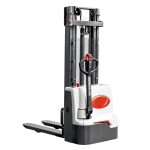
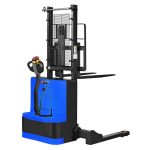
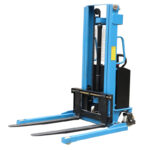
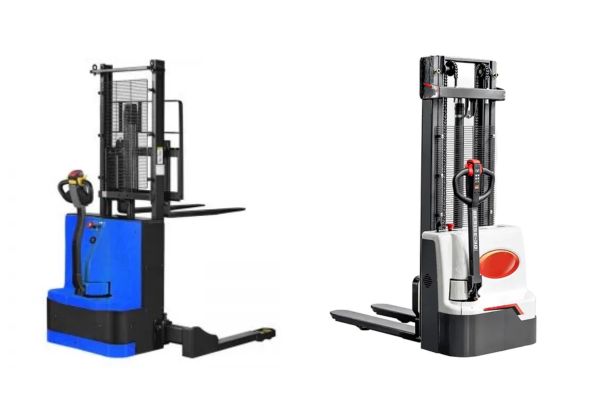
The HH1216JW is a fully powered straddle stacker lift truck designed for general material handling, stacking, and work positioning. Its main advantage is its straddle leg design and wider adjustment range, making it a practical choice for customers who need more flexibility in pallet handling.
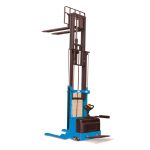
The QES electric stacker is designed for small warehouse operations, with a compact body, ergonomic long tiller, lithium battery, and better operator visibility.
In simple terms:
- HH1216JW straddle leg fully powered stacker is better for customers who need a straddle leg electric stacker with broader structural compatibility.
- QES electric stacker is better for customers who need a compact, economical electric stacker for small warehouse operations.
1. Product Positioning: Two Different Solutions for Two Different Needs
The HH1216JW is positioned as a fully powered straddle leg lift stacker truck. It is suitable for standard warehouse material handling tasks, including pallet transport, stacking, and positioning. Because it uses a straddle leg structure, it is especially useful in applications where pallet dimensions or fork entry conditions require a more adaptable base design.
The QES electric stacker follows a different product logic. It is part of the QES Series, which is marketed as an economical long-tiller pallet stacker. This makes it more attractive for customers who want to improve efficiency while keeping equipment investment under control. Its selling points are not just lifting and travel, but also operator comfort, maneuverability, and compact design.
If your customer is comparing these two models, the first question should be:
Do they need a straddle leg design, or do they need a compact long-tiller stacker for a small warehouse?
2. Design Comparison: Straddle Leg vs Long Tiller Compact Design
One of the most important differences between these two models is the overall structure.
The HH1216JW uses a straddle leg design, with adjustable fork width and leg width. This gives it more flexibility in certain handling situations and makes it suitable for customers who need a machine that can adapt to different pallet or load conditions.
The QES electric stacker focuses on a compact chassis and long tiller design. The long tiller improves ergonomics by reducing operating force and helping the operator keep a safer distance from the truck body. It also improves visibility during pallet handling and stacking, which is especially useful in smaller warehouse environments.
From a marketing perspective, this is the simplest way to explain the difference:
- HH1216JW = structural flexibility
- QES= compact ergonomics
3. Warehouse Suitability: Which One Fits Small Spaces Better?
The QES electric stacker is clearly designed with small warehouse operation in mind. Its compact body and long tiller make it a strong option for warehouses with limited working space, frequent pedestrian operation, and daily pallet movement.
The HH1216JW straddle leg electric stacker is also suitable for general warehouse work, but its wider straddle leg structure means its product appeal is more closely linked to load and pallet compatibility than to “small warehouse” positioning.
That said, buyers should not assume that a narrower body always means a smaller turning radius. In some sales conversations, customers may confuse machine width with actual maneuverability. The better approach is to explain that:
- QES electric stacker offers a narrower overall body and a compact layout
- HH1216JW offers a straddle leg structure with its own maneuvering advantages depending on the application
So if the customer is operating in a small storage area with frequent walking control, the QES is usually easier to position as the better fit. If the customer is more concerned with load structure and handling compatibility, the HH1216JW may be the better option.
4. Lifting Height and Product Range
Another major difference is in lifting range and platform flexibility.
The HH1216JW is a more straightforward solution with a maximum fork height of 1575 mm, making it suitable for standard low- to mid-level stacking work.
The QES Series offer more flexibility across the range, with lifting heights from 1600 mm up to 4000 mm depending on the configuration. This makes the QES platform more attractive for customers who may need different mast options or plan to expand their equipment requirements later.
So if the buyer only needs a simple and effective electric stacker for routine warehouse work, the HH1216JW is easy to position. If the buyer wants more lift height options and a product family that can scale with future needs, the QES has a stronger long-term story.
5. Battery, Safety, and System Features
The HH1216JW is equipped with maintenance-free batteries, a battery discharge gauge, an integral charger, and standard safety features such as an electromagnetic brake, automatic dead-man braking, and an auto-reverse belly button switch. These features make it easy to present as a practical, ready-to-use, low-maintenance warehouse stacker.
The QES takes a more modern equipment approach. The QES Series highlights a lithium battery system, CAN-BUS intelligent control, and a hydraulic lifting system without oil pipe design, which improves reliability and helps reduce leakage risk. These features are ideal for customers who are looking for safer, cleaner, and more intelligent electric stacker operation.
In sales language:
- HH1216JW is strong on practical operation and standard safety
- QES is strong on modern control, lithium power, and system reliability
6. Which Electric Stacker Should You Choose?
Choose the HH1216JW if your customer needs:
- A straddle leg electric stacker
- More flexibility in fork and leg adjustment
- A model for general material handling and stacking
- A practical, straightforward solution for everyday warehouse use
Choose the QES if your customer needs:
- A compact electric stacker for small warehouse operations
- A long tiller design for better ergonomics
- A lithium battery stacker
- Better operator visibility and a more economical full electric solution
Final Thoughts
The HH1216JW and QES12E may both fall into the 1.2 ton electric stacker category, but they are designed for different priorities.
If your customer values straddle leg structure, adjustability, and general handling flexibility, the HH1216JW is the stronger option.
If your customer values compact design, long-tiller ergonomics, lithium battery power, and small warehouse performance, the QES is the better fit.
The best way to recommend one over the other is not to compare load capacity alone. Instead, focus on the customer’s:
- pallet type
- warehouse space
- stacking height
- daily operating frequency
- safety and ergonomics expectations
When you match the product structure to the real working condition, the comparison becomes much easier—and much more convincing.
Related Products
 QES Series Electric Stacker
- Lead-Acid vs. Lithium Battery Pallet Trucks: Which Is the Better Choice for Your Business?
- HS Manual Stacker vs QES Electric Stacker: Which Pallet Stacker Is Right for Your Warehouse?
- HRL Rotating Lift Table vs. ERP2000 Stretch Wrap Machine: How to Choose the Right Solution for Your Pallet Handling Application
- HH1216JW straddle leg fully powered stacker lift truck
- Manual vs Semi-Electric 400kg Light Stacker: Which One Should You Choose?
- BK1545 Heavy duty full electric lift stacker
- EMS1016 Semi-Electric Stacker With Adjustable Fork
- GT1016F Pump-Up Manual Straddle Truck
- Manual Stacker vs. Manual Straddle Stacker: When to Choose Which?