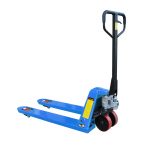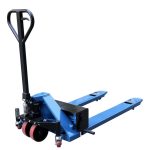



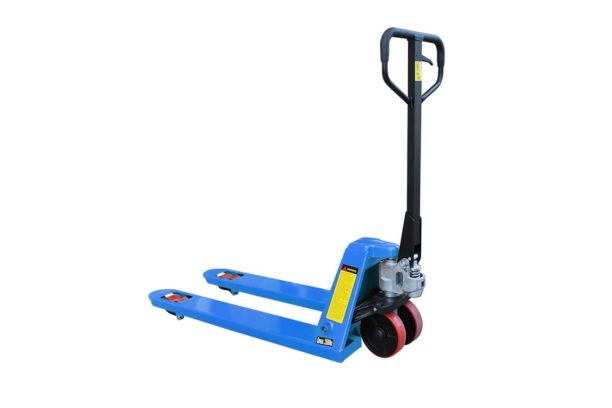
Choosing between a 2500kg manual pallet truck and a 3000kg manual pallet truck may look simple: select the truck with the higher capacity and move on.
In practice, the right choice depends on more than the maximum load rating. Buyers also need to consider pallet dimensions, working frequency, aisle space, floor conditions, operator comfort and the weight of the pallet truck itself.
A 3000kg pallet truck is not automatically the best option for every warehouse. For many everyday material-handling operations, a 2500kg model provides sufficient capacity with a practical balance of maneuverability and cost. In heavier industrial applications, however, the additional capacity of a 3-ton pallet jack can offer greater flexibility.
This guide compares the two options and explains how to select the right hand hydraulic pallet truck for your operation.
Quick Comparison: 2500kg vs 3000kg Pallet Jack
| Comparison Point | 2500kg Manual Pallet Jack | 3000kg Manual Pallet Jack |
|---|---|---|
| Rated capacity | 2,500kg / 5,500lb | 3,000kg / 6,600lb |
| Typical model options | AC25S and AC25L | AC30S and AC30L |
| Best suited for | General warehouse and logistics work | Heavier industrial and manufacturing loads |
| Fork length options | 1150mm or 1220mm | 1150mm or 1220mm |
| Fork overall width options | 540mm or 680mm | 540mm or 680mm |
| Minimum fork height | 75mm or 85mm | 75mm or 85mm |
| Maximum fork height | 190mm or 200mm | 190mm or 200mm |
| Net weight | Approximately 75–78kg | Approximately 78–81kg |
| Main advantage | Practical capacity for common pallet loads | Higher load capacity and more operating flexibility |
The i-Lift AC Series includes four standard configurations: AC25S, AC25L, AC30S and AC30L. Both capacity classes are available with 1150mm or 1220mm forks and 540mm or 680mm overall fork widths.
What Does the Rated Capacity Actually Mean?
The rated capacity tells you the maximum load the manual hydraulic pallet jack is designed to handle under the specified operating conditions.
For example:
- A 2500kg pallet truck is rated to carry up to 2,500kg.
- A 3000kg pallet truck is rated to carry up to 3,000kg.
However, the rated capacity should not be treated as a target for every load. Buyers should select a pallet truck with a capacity above the heaviest load regularly handled at their facility.
Loads must also be centered correctly on the forks. An uneven, unstable or incorrectly positioned load can create a safety risk even when its total weight is below the rated capacity. Operators should never overload the pallet truck or use it on unstable and uneven surfaces.
When Should You Choose a 2500kg Manual Pallet Jack?
A 2.5-ton pallet truck is a practical choice for most standard warehouse, retail, logistics and distribution applications.
It is especially suitable when:
- Most pallet loads are well below 2,500kg.
- The pallet truck is used for routine horizontal transport.
- Operators need to move goods through warehouse aisles or loading areas.
- Lower equipment weight is helpful for frequent manual handling.
- The operation requires a reliable standard pallet truck rather than a specialized heavy-duty model.
Common applications include moving packaged goods, cartons, food products, consumer goods, warehouse supplies and general industrial materials.
The AC25S and AC25L models have net weights of approximately 75kg and 78kg respectively. Their slightly lower equipment weight can be beneficial when operators need to pull, position and turn the truck repeatedly during a shift.
Main Benefits of a 2500kg Pallet Truck
Practical capacity
A 2,500kg rating covers a wide range of standard palletized loads without requiring buyers to invest in more capacity than their operation normally needs.
Easier everyday handling
Because the 2500kg versions are slightly lighter than the corresponding 3000kg models, they may be more convenient for frequent warehouse movement.
Good value for general applications
For businesses that rarely handle loads above 2,500kg, a standard 2.5-ton pallet jack can provide a more economical solution.
Multiple fork configurations
Buyers can choose between short or long fork configurations and narrow or wide overall fork widths, depending on the pallets used in their market.
When Should You Choose a 3000kg Manual Pallet Jack?
A 3-ton manual pallet truck is better suited to operations that regularly handle dense, heavy or variable loads.
Consider the 3000kg version when:
- Some pallet loads exceed 2,500kg.
- Load weights vary significantly between shipments.
- The truck is used in manufacturing, metalworking or heavy industrial environments.
- Buyers want additional rated capacity for future applications.
- A single pallet truck must serve several departments with different load requirements.
Typical applications can include transporting metal parts, machinery components, raw materials, molds, industrial equipment and other high-density goods.
The AC30S and AC30L provide a rated capacity of 3,000kg, while retaining the same fork-length and fork-width choices available in the 2500kg range. Their listed net weights are approximately 78kg and 81kg.
Main Benefits of a 3000kg Pallet Jack
Higher lifting capacity
The additional 500kg of rated capacity allows the truck to handle heavier palletized loads.
Greater operational flexibility
A 3000kg pallet jack can serve both standard warehouse loads and selected heavier applications, reducing the need to keep different trucks for different load ranges.
Suitable for demanding environments
Manufacturing plants, workshops and industrial warehouses often handle heavier or less predictable loads. A 3-ton pallet jack may be a better fit for these conditions.
Useful for business growth
Companies expecting heavier products, larger shipments or changing production requirements may benefit from choosing the higher-capacity model from the beginning.
Does Higher Capacity Make a Pallet Jack Harder to Operate?
Not necessarily, but capacity is only one factor.
The 3000kg models are approximately 3kg heavier than the equivalent 2500kg configurations. The difference is relatively small, but it may become noticeable when operators repeatedly maneuver an unloaded pallet jack in tight spaces.
Load weight has a much greater effect on pulling and steering effort. Moving a 3,000kg load manually will naturally require more effort than moving a lighter load, regardless of the truck’s rated capacity.
Other factors also affect handling:
- Floor condition
- Wheel material
- Pallet quality
- Aisle width
- Turning frequency
- Travel distance
- Ramps or gradients
- Load distribution
For long travel distances, frequent heavy loads or operations involving slopes, an electric pallet truck may be more appropriate than a manual pallet mover.
Fork Size Is Just as Important as Load Capacity
Choosing between 2500kg and 3000kg is only part of the purchasing decision. The pallet jack must also match the dimensions and entry openings of the pallets being handled.
The AC Series offers the following configurations:
S Models: AC25S and AC30S
- Fork length: 1150mm
- Overall fork width: 540mm
- Individual fork width: 160mm
These models are generally suited to pallets requiring a narrower fork spread.
L Models: AC25L and AC30L
- Fork length: 1220mm
- Overall fork width: 680mm
- Individual fork width: 160mm
These models provide longer forks and a wider overall configuration for larger pallet formats.
Before ordering a hand operated pallet jack, measure:
- The pallet entry width
- The pallet depth
- The height of the pallet opening
- The direction from which the pallet will be entered
A pallet truck with the wrong fork dimensions may be unable to enter the pallet properly, even when its capacity is sufficient.
Hydraulic System and Structural Design
Capacity is important, but buyers should also evaluate the construction of the pallet truck.
The i-Lift Standard Hand Hydraulic Pallet Truck uses a fully sealed hydraulic unit housing and a single-valve cartridge designed for easier maintenance. Its chassis is made from high-grade steel with a powder-coated finish.
Additional design features include:
- Tapered forks for easier pallet entry
- Entry rollers to help guide the forks into pallets and skids
- Reinforced forks for demanding loads
- Three-position hand control for raising, neutral movement and lowering
- Spring-loaded self-righting safety loop handle
- Hardened chrome piston with a protective dust cover
- Polyurethane, nylon and rubber wheel configurations
These features make the truck suitable for warehouses, logistics centers, workshops, factories, packaging operations and other material-handling environments.
Which Wheel Type Should You Choose?
Wheel material can significantly influence noise, rolling resistance, floor protection and durability.
Polyurethane Wheels
Polyurethane wheels are a popular all-around choice for indoor warehouses. They offer relatively quiet movement and help protect finished floors.
Choose polyurethane wheels for:
- Warehouses
- Retail storage areas
- Distribution centers
- Smooth concrete floors
- Operations where lower noise is preferred
Nylon Wheels
Nylon wheels are hard, durable and generally provide low rolling resistance on smooth surfaces.
Choose nylon wheels for:
- Heavy loads
- Hard industrial floors
- Applications where easy rolling is important
- Environments where minor wheel noise is acceptable
Rubber Steering Wheels
Rubber steering wheels can provide good grip and quieter operation, although they may require more pulling effort than harder wheel materials.
Choose rubber steering wheels for:
- Noise-sensitive working areas
- Floors requiring additional grip
- Light-to-medium warehouse applications
The best wheel configuration depends on floor conditions, load weight and working frequency—not only the pallet truck’s maximum capacity.
2500kg vs 3000kg: Which One Offers Better Value?
The better value is the model that matches your real operating requirements.
Choose the 2500kg hand pallet truck when your heaviest regular loads remain comfortably below 2,500kg. It provides practical capacity for most standard pallet-moving tasks while keeping the equipment slightly lighter.
Choose the 3000kg hydraulic pallet truck when your operation handles heavier goods, load weights change frequently or additional capacity may be required in the future.
Purchasing too little capacity may limit operations and create an overloading risk. Purchasing significantly more capacity than necessary may provide little practical benefit for a warehouse handling only light or medium pallet loads.
The buying decision should therefore be based on:
- Maximum actual pallet weight
- Frequency of heavy-load handling
- Pallet dimensions
- Travel distance
- Aisle and turning space
- Floor conditions
- Operator workload
- Future business requirements
Practical Selection Examples
General Distribution Warehouse
Most loads weigh between 500kg and 1,800kg, and pallets are moved over short distances.
Recommended option: 2500kg manual pallet jack.
The 2.5-ton capacity is sufficient for normal loads and offers a practical solution for frequent warehouse use.
Manufacturing Facility
Loads regularly weigh between 2,000kg and 2,700kg, including components and raw materials.
Recommended option: 3000kg manual pallet jack.
The additional capacity is necessary for heavier loads and provides greater flexibility.
Warehouse With Mixed Customers
The facility handles products from several customers, and pallet weights vary considerably.
Recommended option: 3000kg pallet truck.
A higher rated capacity can help the same truck support a wider range of shipments.
Retail or Packaging Operation
Most loads are light, but the truck is used frequently throughout the day.
Recommended option: 2500kg hand pallet trolley.
The operation benefits more from practical handling than from additional unused capacity.
Frequently Asked Questions
Is a 2500kg pallet jack enough for warehouse use?
For many standard warehouse operations, yes. A 2500kg pallet jack is suitable when the heaviest pallet remains below the truck’s rated capacity and is properly centered on the forks.
Can a 2500kg pallet jack lift exactly 2500kg?
It is rated for a maximum load of 2,500kg under the specified conditions. However, the truck should never be overloaded, and operators should verify the actual load weight, load distribution and equipment condition before use.
Is a 3000kg pallet jack always more durable?
Not automatically. Capacity and durability are related to the truck’s design, materials, hydraulic system, wheels, maintenance and operating environment. A higher capacity rating alone does not eliminate the need for correct use and regular inspection.
Can both models handle the same pallet sizes?
The AC Series 2500kg and 3000kg models are available with equivalent fork configurations. Buyers can select 1150 × 540mm or 1220 × 680mm arrangements according to their pallet dimensions.
What is the difference between a pallet jack and a pallet truck?
The terms pallet jack, pallet truck, hand pallet truck, hydraulic pallet jack and hand pallet trolley are often used to describe the same type of manually operated material-handling equipment.
Should I choose a manual or electric pallet truck?
A manual pallet truck is practical for short-distance movement, moderate working frequency and level floors. For longer routes, frequent heavy loads or high-throughput operations, an electric pallet truck may reduce operator effort.
Final Recommendation
For general warehousing, logistics, retail and packaging operations, a 2500kg manual pallet jack is usually the most practical choice. It provides sufficient capacity for common palletized goods and is slightly lighter for everyday handling.
For manufacturing plants, industrial warehouses and facilities handling dense or unpredictable loads, a 3000kg manual pallet jack provides more capacity and greater operating flexibility.
Whichever capacity you select, make sure the fork length, overall fork width, minimum fork height and wheel material match your pallets and working environment.
The i-Lift Standard Hand Hydraulic Pallet Truck is available in 2500kg and 3000kg capacities, with multiple fork and wheel configurations for different material-handling requirements.
Need help selecting the right model?
Explore the Standard Hand Hydraulic Pallet Truck range or contact i-Lift with your pallet dimensions, maximum load weight, floor conditions and required quantity. Our team can help you compare AC25S, AC25L, AC30S and AC30L configurations and identify the most suitable pallet handling solution.
Related Products
 Manual Pallet Truck Buying Guide: Capacity, Fork Size, Wheels and Hydraulic System
- HS Manual Stacker vs QES Electric Stacker: Which Pallet Stacker Is Right for Your Warehouse?
- What to Consider When Buying a Hand Hydraulic Pallet Truck
- Rough Terrain Pallet Truck vs Standard Hand Pallet Truck: Which One Do You Need?
- Flexible Handling Redefined: i-Lift AFPT1000E Adjustable Fork Pallet Truck
- How to Choose the Right Manual Stacker
- Manual High Lift Pallet Trucks: The Ultimate Solution for Efficient Warehouse Operations
- Optimizing Warehouse Efficiency: A Data-Driven Guide to Manual vs. Electric Pallet Trucks
- A Comprehensive Guide to iLift’s Full Range of Pallet Handling Equipment
- Why Hydraulic Toe Jacks Have Two Capacities (Toe vs Head)