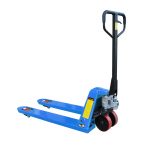



A hand pallet truck is one of the simplest and most widely used tools for moving palletized goods. In warehouses, factories, distribution centers and retail stockrooms, a standard hand pallet truck can move heavy pallets quickly with very little maintenance.
But what happens when the pallet needs to leave the warehouse?
Gravel, rough concrete, construction sites, outdoor yards and uneven surfaces can turn a simple pallet-moving job into a difficult task. Small pallet truck wheels that work perfectly on a smooth warehouse floor may struggle as soon as they encounter stones, cracks, gaps or soft ground.
This is where a rough terrain pallet truck becomes a very different solution.
So, should you choose a standard hand pallet truck or a rough terrain pallet truck?
The answer depends less on which truck looks stronger and more on where you need to use it.
Start With the Ground, Not Just the Load
When choosing a pallet truck, many buyers start with one question:
How much weight do I need to move?
Load capacity is important, but it should not be the only consideration.
A pallet truck can have more than enough capacity for your load and still be unsuitable if its wheels cannot travel across the working surface.
A better first question is:
What kind of ground will the pallet truck operate on?
If the route consists mainly of smooth, level concrete inside a warehouse or factory, a standard hand pallet truck is usually the better choice.
If the route includes gravel, rough paving, outdoor yards, construction areas or other uneven surfaces, a rough terrain pallet truck may be much more suitable.
In simple terms:
Smooth and level floor → Standard Hand Pallet Truck
Rough and uneven ground → Rough Terrain Pallet Truck
When a Standard Hand Pallet Truck Is the Better Choice
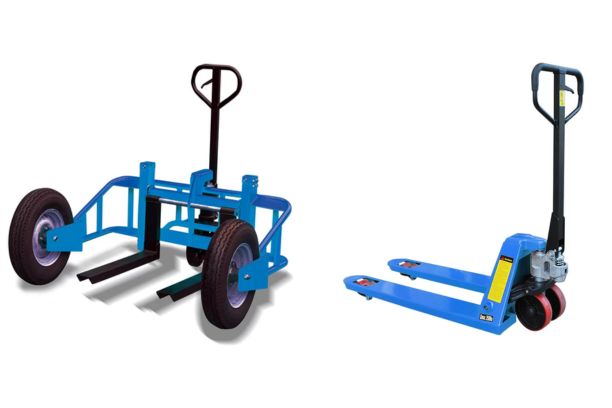
The AC Series Standard Hand Pallet Truck is designed for conventional pallet handling on firm and level floors.
This type of pallet truck is ideal for applications such as:
- Warehouses
- Distribution centers
- Manufacturing facilities
- Retail stockrooms
- Packaging areas
- Loading and unloading zones
- Short-distance indoor pallet movement
Its compact construction makes it easy to maneuver around pallets, racks and warehouse aisles.
Small load rollers also provide low rolling resistance on smooth industrial floors, helping operators move heavy loads efficiently with manual effort.
For a business that mainly handles pallets indoors, there is often no need to use a larger and more specialized rough terrain truck.
A standard hand pallet truck is simpler, more compact and better suited to everyday warehouse work. The AC Series is specifically intended for use on firm, level surfaces and is not recommended for holes, severe bumps, loose debris or unstable ground.
Why Standard Pallet Trucks Struggle Outdoors
The main limitation of a standard pallet truck is not usually its lifting capacity.
It is the size and position of its load wheels.
Standard pallet trucks use relatively small rollers underneath the forks. On a smooth concrete floor, this design works extremely well.
On rough ground, however, those same small wheels can have difficulty passing over:
- Gravel
- Small stones
- Cracks in concrete
- Gaps between paving blocks
- Uneven road surfaces
- Surface transitions
- Loose debris
Instead of rolling over the obstacle, the wheel may stop against it.
The operator then has to apply much more force, reposition the truck or find another route.
This is why a conventional pallet jack that works perfectly inside a warehouse may become impractical in an outdoor yard.
What Makes a Rough Terrain Pallet Truck Different?
The RP Series Rough Terrain Pallet Truck is designed specifically for applications where ordinary pallet trucks may have difficulty operating.
The most obvious difference is the wheel design.
Instead of small load rollers, the RP Series uses large pneumatic front wheels. These wheels are designed to roll across uneven surfaces more easily and help reduce vibration when traveling over rough ground. The truck also uses wider steering wheels and an adjustable fork arrangement for different pallet or load configurations.
This makes the rough terrain pallet truck suitable for environments such as:
- Construction sites
- Builders' yards
- Garden centers
- Agricultural facilities
- Outdoor storage areas
- Rough industrial yards
- Uneven paved surfaces
- Locations where an ordinary pallet truck cannot operate effectively
The goal is not to replace a standard warehouse pallet truck.
It is to make pallet handling possible in places where standard pallet truck wheels become the limiting factor.
Why Large Wheels Matter on Uneven Ground
Wheel size makes a major difference when moving a pallet across rough terrain.
Imagine pushing a small shopping-cart wheel over a stone.
The wheel may stop immediately.
A larger wheel can approach the same obstacle at a much better angle and roll over it more easily.
The same principle applies to pallet trucks.
Large pneumatic wheels can provide better obstacle-crossing capability on:
- Gravel
- Broken pavement
- Small surface depressions
- Outdoor yards
- Rough construction areas
Pneumatic tires can also help absorb some of the vibration caused by irregular ground.
This does not mean that a rough terrain pallet truck can operate safely on every possible surface. The ground still needs to be sufficiently stable to support the truck and its load.
But for suitable outdoor environments, the difference compared with small warehouse rollers can be significant.
Higher Capacity Does Not Always Mean Better
One common mistake when comparing pallet trucks is assuming that the model with the higher load capacity must be the better machine.
That is not necessarily true.
The AC Series standard hand pallet truck is available in higher-capacity configurations than the RP Series rough terrain models. But this does not make the standard pallet truck more suitable for outdoor use.
The two trucks are solving different problems.
The standard pallet truck prioritizes:
- High-capacity pallet handling
- Compact dimensions
- Easy warehouse maneuverability
- Low rolling resistance on smooth floors
The rough terrain pallet truck prioritizes:
- Outdoor mobility
- Larger wheels
- Better obstacle-crossing ability
- Adaptability to irregular ground
So the correct choice should be based on the entire application rather than capacity alone.
The right pallet truck is not always the one with the highest capacity. Ground conditions can be just as important as load weight.
Where the Standard Hand Pallet Truck Has the Advantage
A rough terrain pallet truck is more specialized, but that does not make it better for every application.
Inside a normal warehouse, the standard hand pallet truck usually has several advantages.
It is more compact, easier to maneuver between racks and better suited to restricted spaces.
This makes it particularly useful when:
- Aisles are narrow
- Pallets are closely positioned
- The floor is smooth
- The truck is used frequently throughout the day
- Turning space is limited
Large outdoor wheels require a wider chassis, so a rough terrain truck naturally takes up more working space.
If your entire operation takes place on smooth warehouse flooring, choosing a rough terrain model would usually add size without solving an actual problem.
Where the Rough Terrain Pallet Truck Has the Advantage
The situation changes when the pallet route moves outside.
Consider a garden center receiving pallets of soil or plants.
A warehouse may have a concrete floor, but the outdoor sales and storage areas may include paving, gravel and uneven ground.
Or consider a construction site where pallets of materials need to be transported across temporary roads or unfinished surfaces.
A conventional pallet truck may not be able to complete the route efficiently.
In these situations, a rough terrain pallet truck becomes a practical alternative because the large wheel system is designed around the surface conditions.
The RP Series is specifically intended for applications including construction sites, builders' yards and garden centers where ordinary pallet trucks or forklifts may not always be practical.
Adjustable Forks Can Help With Outdoor Loads
Warehouse pallet handling tends to be highly standardized.
Outdoor material-handling applications are often less predictable.
Construction materials, landscaping products and agricultural supplies may arrive on different pallet sizes or load arrangements.
The RP Series therefore uses adjustable forks, allowing the operator to adapt the fork position to different pallet or load widths within the machine's operating range.
This flexibility can be particularly useful in environments where the same truck needs to handle several different types of loads.
Before purchasing, however, the actual pallet dimensions and entry points should always be confirmed.
What If You Work Both Indoors and Outdoors?
Many businesses operate in both environments.
For example:
Warehouse → doorway → outdoor yard → storage area
In this situation, focus on the most difficult part of the route.
If the outdoor section consists of smooth concrete and only a short distance, a standard hand pallet truck may still be sufficient.
If the outdoor section contains gravel, broken paving or significant surface irregularities, the rough terrain model may provide a much more practical solution.
Another option is to use different equipment for different areas:
- Standard hand pallet trucks inside the warehouse
- Rough terrain pallet trucks for outdoor pallet movement
For operations with frequent pallet movements, separating the equipment by working environment can sometimes provide better efficiency than asking one machine to perform every task.
Which Pallet Truck Should You Choose?
Choose a Standard Hand Pallet Truck if:
- Most work takes place indoors
- Floors are smooth and level
- You handle conventional pallets
- Working space is limited
- Narrow-aisle maneuverability is important
- You need efficient short-distance pallet movement
Choose a Rough Terrain Pallet Truck if:
- Pallets need to move outdoors regularly
- The route includes gravel
- Concrete or paving is rough or uneven
- You work in a construction environment
- You operate in a garden center or outdoor storage yard
- Small pallet jack wheels frequently become stuck
- Different pallet widths require greater fork flexibility
The decision should always start with your real working conditions.
Choosing the Right Pallet Truck Starts With the Route
A standard hand pallet truck and a rough terrain pallet truck may perform the same basic function: lifting a pallet slightly from the ground and moving it manually.
But they are designed for very different environments.
The standard hand pallet truck is optimized for smooth floors, compact working spaces and conventional warehouse pallet handling.
The rough terrain pallet truck is designed for outdoor operations and uneven surfaces where ordinary pallet truck wheels may struggle.
Before choosing your equipment, look at the entire route from the pallet's starting point to its final destination.
Consider:
- Ground condition
- Load weight
- Pallet dimensions
- Indoor or outdoor operation
- Available working space
- Surface transitions
- Travel distance
- Frequency of use
Selecting the pallet truck that matches the actual environment can make material handling easier, more efficient and more reliable.
Need Help Choosing Between a Standard and Rough Terrain Pallet Truck?
If you are not sure which type of pallet truck is suitable for your application, send us information about your load and working environment.
Photos or videos of the operating surface can be especially helpful for outdoor applications.
Our material-handling team can help you evaluate your working conditions and recommend a suitable solution.
Explore the AC Series Standard Hand Pallet Truck for warehouses, factories and other smooth-floor applications.
Explore the RP Series Rough Terrain Pallet Truck for outdoor yards, construction sites and uneven-ground applications.
Related Products
 What to Consider When Buying a Hand Hydraulic Pallet Truck
- Market Insights and Selection Guide for Hand Pallet Trucks, Small Capacity Hand Lifters
- Lead-Acid vs. Lithium Battery Pallet Trucks: Which Is the Better Choice for Your Business?
- Why Hydraulic Toe Jacks Have Two Capacities (Toe vs Head)
- 2500kg vs 3000kg Manual Pallet Truck: A Practical Comparison
- How to Choose the Right Electric Pallet Truck for Your Warehouse
- Manual Pallet Truck Buying Guide: Capacity, Fork Size, Wheels and Hydraulic System
- Safety Swing Gate vs Mezzanine Gate: What’s the Difference and Which One Should You Choose?
- When Do You Need a U-Shape Low Profile Stationary Lift Table?
- Foldable Lifter LPT250