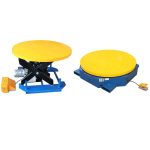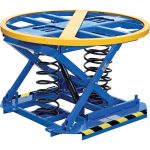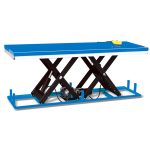



In modern warehouses, factories, and logistics centers, improving efficiency and protecting workers’ health are two major priorities. One essential piece of equipment that helps achieve both goals is the rotating lift table. By combining vertical lifting with a rotating platform, these devices allow operators to load and unload goods at an ergonomic height while rotating the surface for easy access to all sides.
Among the most popular options on the market today are:
Airbag Lift Tables
Spring Lift Tables
Full Electric Rotating Lift Tables
Although these products may look similar at first glance, their working principles, performance, and applications differ significantly. In this article, we will compare these three types in detail, highlight their advantages, and help you choose the most suitable solution for your operation.
Why Rotating Lift Tables Matter in Material Handling
Before diving into the comparison, it is important to understand why rotating lift tables are widely used in industrial environments.
Traditional pallet handling often requires workers to bend, twist, and stretch repeatedly. Over time, this leads to fatigue, back pain, and even long-term injuries. Rotating lift tables solve these problems by:
Keeping loads at an ergonomic working height
Allowing 360-degree rotation for easy access
Reducing bending, reaching, and walking
Improving productivity and workflow efficiency
Enhancing workplace safety
By maintaining a comfortable working posture, operators can complete loading and unloading tasks faster and with less physical strain.
Airbag Lift Table (Pneumatic Self-Leveling Solution)
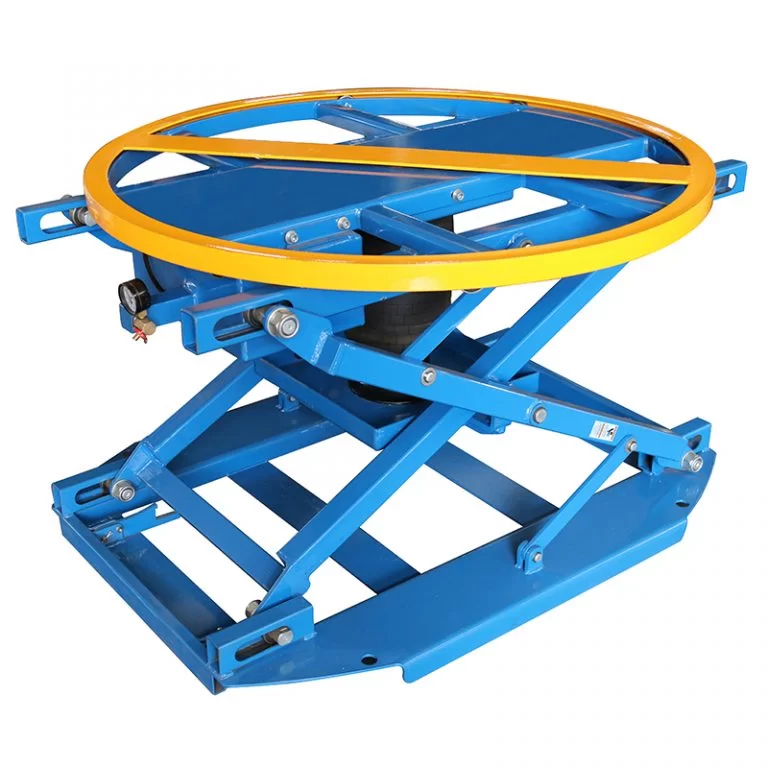
How It Works
The Airbag Lift Table uses a pneumatic system with inflatable airbags to support and lift the platform. When weight is added, the air inside the airbags compresses, lowering the platform. When weight is removed, the airbags expand, raising the surface.
By adjusting the air pressure, operators can fine-tune the lifting capacity and working height. This makes the airbag system highly flexible and responsive.
Key Advantages
1. Self-Leveling Performance
Like spring lift tables, airbag lift tables are self-leveling. As goods are added or removed, the platform automatically adjusts to stay at a comfortable height. No manual height control is required during operation.
2. Superior Stability and Shock Absorption
Compared with spring-loaded systems, airbag lift tables are generally more stable. The compressed air inside the airbags absorbs vibration and shock, making the platform:
Less likely to bounce
Less prone to sudden movement
More comfortable for operators
This feature is especially important when handling fragile or high-value goods.
3. Flexible Load Adjustment
One of the biggest advantages of airbag lift tables is their adjustable load capacity. By simply inflating or deflating the airbags, operators can:
Change the working load range
Adapt to different product weights
Optimize ergonomic height
This adjustment can be done even when heavy goods are already on the platform, without removing the load.
4. Wide Load Range
Airbag systems support very light loads as well as heavier ones. In many cases, the minimum load can be less than 100 kg, or even lower, making them suitable for lightweight packaging, electronics, and small components.
5. Easy Maintenance and Operation
Load adjustment is simple and fast. Operators only need to use an air pump to control air pressure. No mechanical disassembly is required for routine adjustments.
Limitations
Requires an air pump or compressed air source
Initial installation may require pneumatic setup
Slightly higher upfront cost than basic spring systems
Ideal Applications
Airbag lift tables are best for:
Operations with frequently changing loads
Handling both light and medium-weight goods
Workstations requiring high stability
Facilities with existing compressed air systems
Spring Lift Table (Mechanical Self-Leveling Solution)
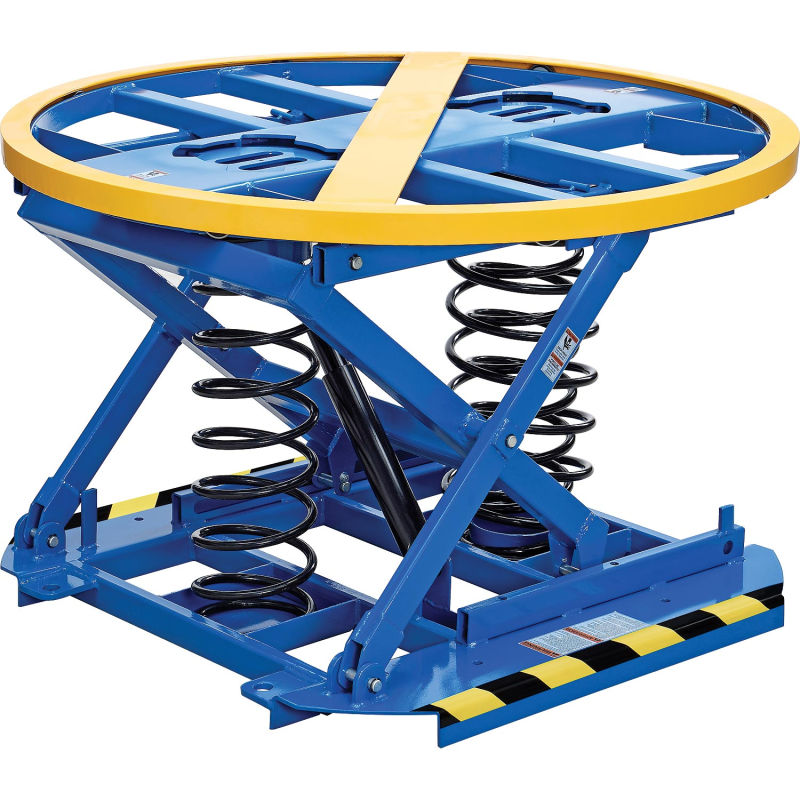
How It Works
Spring Lift Tables rely on mechanical springs installed beneath the platform. Typically, three main springs are used. As weight is added, the springs compress and lower the table. As weight is removed, they expand and raise it.
Once properly calibrated for a specific maximum load, the table automatically maintains an ergonomic height throughout the loading or unloading process.
Key Advantages
1. Self-Leveling Function
Like airbag systems, spring lift tables are self-leveling. They automatically respond to changes in weight and keep the platform at a comfortable height for workers.
This feature makes them highly effective for repetitive pallet handling tasks.
2. Simple and Reliable Structure
Spring systems are purely mechanical. There are no electrical or pneumatic components, which means:
Lower risk of system failure
Minimal energy consumption
Long service life
This simplicity makes spring lift tables popular in many traditional warehouses.
3. Low Operating Cost
Since they do not require electricity or compressed air, operating costs are very low. Maintenance is also relatively simple.
4. Proven Industrial Solution
Spring pallet positioners have been used in material handling for decades. Their reliability and performance are well tested in real-world environments.
Limitations
1. Limited Load Adjustment
Spring lift tables typically use three springs that can be combined in different ways. This results in only a few preset load configurations.
Unlike airbag systems, you cannot adjust the load capacity continuously.
2. Load Adjustment Requires Disassembly
To change the load range, operators must:
Remove the platform
Replace or rearrange springs
Reinstall the system
This process is time-consuming and inconvenient, especially in busy operations.
3. Higher Minimum Load
The minimum load is usually around 440 kg. This makes spring systems unsuitable for very light goods.
4. Lower Shock Absorption
Compared with airbag systems, spring lift tables provide less vibration damping and may feel less stable when loads change suddenly.
Ideal Applications
Spring lift tables are best for:
Operations with stable, consistent loads
Heavy pallet handling
Environments without air or power supply
Cost-sensitive projects
Full Electric Rotating Lift Table (Powered Control Solution)
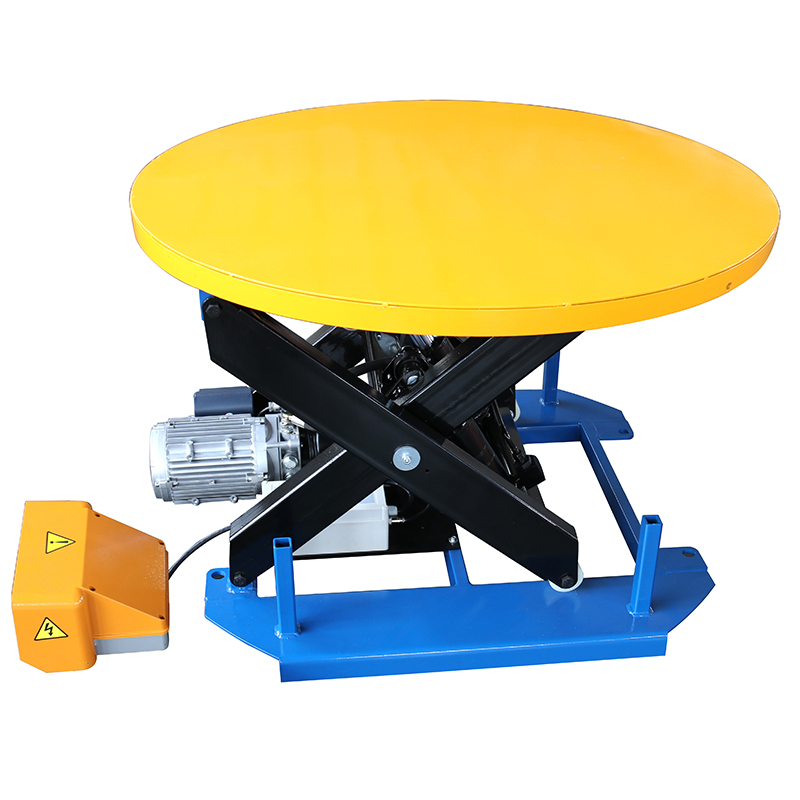
How It Works
The Full Electric Rotating Lift Table uses an electric motor and control system to raise, lower, and rotate the platform. Operators adjust the height using buttons, pedals, or control panels.
Unlike airbag and spring systems, electric models rely on powered movement rather than automatic mechanical or pneumatic balancing.
Key Advantages
Precise height control
Suitable for heavy-duty applications
Can integrate with automated systems
Supports consistent performance under high loads
Limitations
No Self-Leveling Function
The main disadvantage is that electric rotating lift tables are not self-leveling. The platform does not automatically adjust when weight changes.
Operators must manually control the height every time the load changes, which can:
Reduce efficiency
Increase operator workload
Interrupt workflow
Higher Operating Cost
Electric systems require power supply, electrical maintenance, and safety inspections, which may increase long-term costs.
Ideal Applications
Electric rotating lift tables are best for:
Automated production lines
Heavy industrial processes
Situations requiring precise positioning
Facilities with stable power supply
Airbag vs. Spring vs. Electric: Key Comparison
| Feature | Airbag Lift Table | Spring Lift Table | Full Electric Lift Table |
| Self-Leveling | Yes | Yes | No |
| Load Adjustment | Continuous via air pressure | Limited spring combinations | Manual electric control |
| Stability | Excellent | Moderate | High |
| Minimum Load | <100 kg possible | Around 440 kg | Depends on model |
| Adjustment Convenience | Very easy | Requires disassembly | Easy but manual |
| Power Requirement | Air pump | None | Electricity |
| Best For | Variable loads | Stable heavy loads | Automated systems |
The Importance of Rotating Platforms
All three models feature a rotating platform, which brings major ergonomic benefits.
By rotating the surface, workers can:
Access all sides of a pallet without walking around
Maintain the same posture
Avoid excessive twisting
Complete tasks faster
This not only improves productivity but also protects workers from long-term bending and repetitive strain injuries.
How to Choose the Right Rotating Lift Table
When selecting a rotating lift table, consider the following factors:
1. Load Characteristics
Frequently changing weights → Airbag
Stable heavy loads → Spring
Very heavy or automated loads → Electric
2. Working Environment
With compressed air → Airbag
Without utilities → Spring
With reliable power → Electric
3. Ergonomic Requirements
If minimizing manual adjustment is critical, self-leveling systems (airbag or spring) are the best choice.
4. Budget and Maintenance
Lowest operating cost → Spring
Best flexibility → Airbag
Highest precision → Electric
Conclusion
Rotating lift tables play a vital role in modern material handling by improving efficiency, safety, and ergonomics. While Airbag Lift Tables, Spring Lift Tables, and Full Electric Rotating Lift Tables share similar external designs, their internal mechanisms lead to very different performance characteristics.
Airbag Lift Tables offer the best flexibility, stability, and ease of adjustment, making them ideal for operations with variable loads.
Spring Lift Tables provide a reliable, low-cost self-leveling solution for consistent heavy loads.
Full Electric Rotating Lift Tables deliver precise powered control but lack automatic self-leveling.
For businesses seeking a versatile, ergonomic, and user-friendly solution, airbag and spring systems remain the most practical choices. By understanding their differences and advantages, you can select the right rotating lift table to optimize your workflow and protect your workforce for years to come.
Related Products
 Electric Lift Table Cart Buying Guide: What to Consider Before You Buy
- Lead-Acid vs. Lithium Battery Pallet Trucks: Which Is the Better Choice for Your Business?
- When Do You Need a U-Shape Low Profile Stationary Lift Table?
- HRL Rotating Lift Table vs. ERP2000 Stretch Wrap Machine: How to Choose the Right Solution for Your Pallet Handling Application
- QSL1000 Spring Lift Table & QAL1000 Airbag Lift Table
- LT10M & LT10E Pallet Tilters by i-lift: The Smart Choice for Ergonomic & Efficient Material Handling
- HW2000D large platform lift table
- The 2025 Ultimate Guide to Electric Pallet Jacks
- Vertical Material Handling Solutions: Analysis of 7 Types of Pallet Trucks and Their Application Scenarios
- How to chose the suitable lift table?