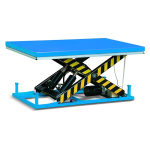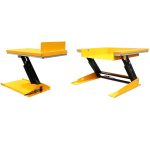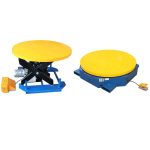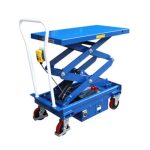



When a customer asks for an electric rotating lift table, the first instinct is often to recommend a standard heavy-duty model. But what if the required load is only 300kg, while the available full electric rotating lift table starts from 1000kg capacity?
Technically, the 1000kg model can do the job. Commercially, however, it may not be the best choice.
For many light-duty applications, using a heavy-duty rotating lift table can mean unnecessary capacity, higher cost, and lower overall value for the customer. That is why it is worth asking a more practical question:
Does a 300kg application really need a 1000kg rotating lift table?
In many cases, the answer is no.
The Problem with Overspecification
A 1000kg full electric rotating lift table is designed for demanding industrial applications. It is usually built for higher loads, more frequent duty cycles, stronger structural requirements, and more robust long-term performance.
If the customer only needs to handle 300kg, this type of machine may be oversized in several ways:
- higher load capacity than the application requires
- higher machine cost
- potentially higher maintenance and shipping costs
- lower price competitiveness during quotation
From the customer’s point of view, paying for unused capacity is rarely attractive. Even if the machine works perfectly, the overall cost-performance ratio may not be ideal.
This is especially true when the customer is looking for a practical solution rather than the highest possible specification.
A More Cost-Effective Alternative
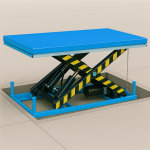
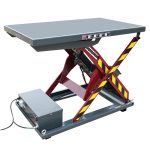
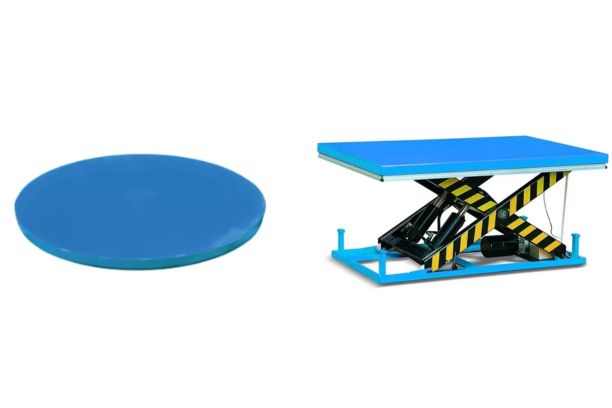
For light-duty applications, a more economical approach may be to combine:
to create a functional Electric Rotating Lift Table.
In this configuration, the turntable is mounted on top of the lift table platform. Visually, the result still looks like a complete rotating lift table. Functionally, it can still provide both lifting and rotating movement. And commercially, it can be much more cost-effective than using a 1000kg heavy-duty model.
For customers, what matters most is not whether the machine started as two subsystems or one integrated design. What matters is whether it can safely deliver the required lifting and rotating performance at a reasonable price.
Why This Design Can Make Sense for 300kg Loads
A 300kg application often falls into the light-duty or medium-duty category. If the working conditions are not especially demanding, a combined design can be a practical solution.
This approach offers several advantages.
1. Better Matching of Capacity to Actual Demand
If the customer only needs 300kg, it may be more reasonable to design around that real requirement rather than pushing a 1000kg machine.
A properly selected stationary lift table and turntable can provide sufficient performance without excessive overdesign.
2. Lower Total Equipment Cost
A light-duty lifting platform combined with a suitable turntable can often reduce equipment cost compared with a standard heavy-duty rotating lift table. This makes the quotation more competitive and may improve the chance of winning the order.
3. Similar Appearance to a Full Rotating Lift Table
When the turntable is mounted on the top platform, the equipment still looks like a standard electric rotating lift table. From the customer’s perspective, it remains a complete industrial solution rather than a temporary modification.
4. Easier Product Positioning
This kind of design can also help manufacturers expand their product range. Instead of offering only heavy-duty rotating lift tables, they can provide a lighter and more economical series for 300kg or 500kg applications.
But It Is Not Just a Simple Combination
Although the idea is practical, it should not be treated as a casual assembly of two separate products. Once the turntable is mounted on the lift table, the equipment must be evaluated as one complete machine.
This is the most important point.
A lift table plus a turntable may look simple, but the final machine must still meet the customer’s requirements for safety, stability, and durability. The fact that each individual component has its own load rating does not automatically mean the combined machine is suitable.
Key Engineering Considerations
Before recommending this solution, several technical factors should be reviewed carefully.
Load Distribution
A 300kg load is not always evenly distributed. In real applications, the load may be eccentric or off-center. This matters because off-center loading affects platform stability, scissor mechanism stress, and rotational smoothness.
If the application involves pallets, irregular goods, or one-sided loading, the structure must be checked accordingly.
Platform Stability
When a turntable is mounted on top of the lift table, the overall platform height increases. This raises the center of gravity of the load. If the platform lifts to a higher position, stability becomes even more important.
The design should consider:
- lifting height
- platform diameter or size
- center of gravity
- off-center loading conditions
- dynamic effects during rotation
Rotation Requirements
Not every application needs the same type of rotation. Important questions include:
- Does the customer need 360° continuous rotation?
- Is indexed positioning enough, such as 90° or 180°?
- Is rotation required under load?
- What rotation speed is needed?
These factors influence turntable selection, drive design, and wiring arrangement.
Wiring and Power Transmission
If the machine has electric rotation, cable management becomes critical. Rotating elements can create wiring challenges, especially when repeated rotation is involved.
The design may require:
- cable protection
- anti-twist solutions
- rotation limits
- slip ring solutions in some cases
A machine that lifts and rotates must not only work mechanically, but also remain reliable electrically.
Safety Protection
A combined rotating lift table should include the same level of safety thinking expected from a complete machine. Depending on the application, this may include:
- emergency stop
- upper and lower travel limits
- overload protection
- anti-pinch protection
- rotation limitation or positioning control
- safety interlock logic between lifting and rotating functions
For example, some applications may require limited or slower rotation when the platform is lifted to a higher position.
Duty Cycle
A combined light-duty solution is often suitable for moderate use. But if the machine will run continuously throughout the day, or in a demanding production line, a fully integrated heavy-duty rotating lift table may still be the better option.
Usage frequency matters just as much as load capacity.
When This Solution Is a Good Fit
A turntable-on-top stationary lift table design can be a very good option when the application has the following characteristics:
- load around 300kg
- moderate lifting height
- controlled or limited off-center loading
- relatively low or medium operating frequency
- slow or moderate rotation speed
- strong focus on budget and cost performance
In these cases, the customer may benefit from a machine that delivers the required function without paying for unnecessary heavy-duty capacity.
When a 1000kg Integrated Rotating Lift Table Is Still Better
There are also cases where the heavier integrated solution remains the right choice.
For example:
- high lifting height
- high-frequency operation
- significant off-center loading
- demanding industrial environments
- strict stability requirements
- continuous rotation under load
- need for long-term heavy-duty performance
In these situations, a true full electric rotating lift table may provide better structural reliability and a longer service life.
So the issue is not whether a 1000kg machine is good or bad. The issue is whether it is the right fit for the actual application.
The Better Question to Ask
Instead of starting with the machine capacity alone, it is better to begin with the application details:
- What is the real load?
- What is the platform size?
- What lifting height is required?
- Is the load centered or off-center?
- Does the platform need continuous rotation or fixed-position rotation?
- How many cycles will it perform per day?
- What level of safety protection is needed?
Once these details are clear, the correct solution becomes much easier to identify.
In many 300kg applications, the most economical answer may not be a standard 1000kg rotating lift table. It may be a lighter custom rotating lift table based on a stationary lift table and a turntable.
Conclusion
A 300kg application does not automatically require a 1000kg rotating lift table.
While a heavy-duty full electric rotating lift table can certainly handle the job, it may also increase cost beyond what the application actually needs. For many light-duty and medium-duty applications, a stationary lift table combined with a top-mounted turntable can be a practical and cost-effective alternative.
The key is proper evaluation. Load distribution, lifting height, stability, rotation requirements, electrical design, and safety protection must all be considered before finalizing the solution.
When these factors are properly matched, a lighter rotating lift table can offer the customer exactly what they need: reliable performance, standard industrial appearance, and better overall value.
If you are selecting a rotating lift table for a 300kg application, the goal should not be to choose the biggest machine. The goal should be to choose the most suitable one.
Need Help Choosing the Right Rotating Lift Table?
If you are evaluating a rotating lift table for your application, prepare the following information before requesting a quotation:
- load capacity
- platform size
- lifting height
- rotation angle or rotation type
- load distribution condition
- working frequency
- application environment
With these details, it is much easier to determine whether a full electric rotating lift table or a more cost-effective combined solution is the better choice.
Related Products
 Custom Stationary Lift Table: Key Factors You Must Consider Before Ordering
- ALT Series Buying Guide: Key Parameters to Confirm Before Purchasing a Lift and Tilt Table
- HRL Rotating Lift Table vs. ERP2000 Stretch Wrap Machine: How to Choose the Right Solution for Your Pallet Handling Application
- Electric Lift Table Cart Buying Guide: What to Consider Before You Buy
- iWCRP-2 Heavy-Duty Rotating Roller Machine Skates: Why They Outperform Popular Alternatives
- Pit-Mounted vs Surface-Mounted Stationary Lift Tables: Which Is Right for You?
- Boost Logistics Efficiency with i-lift SF Series Fixed Type Skates: A Comprehensive Guide
- How to Select an Electric Lift Table for Fine Metal Dust Environments
- Advantages of Self-Loading Electric Stackers in Factory Operations
- Manual vs Semi-Electric 400kg Light Stacker: Which One Should You Choose?