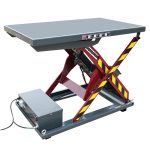



In industrial environments where fine powders, metal dust, or airborne particles are present, buyers often ask the same question:
Does dust-protected equipment mean it is explosion-proof?
The answer is no.
Dust protection and explosion protection address different risks. A machine may be designed to reduce dust entering its electrical components without being certified for use in an explosive atmosphere.
Understanding this distinction is especially important when selecting electric lift tables, material-handling equipment, motors, control boxes, switches, and other electrically powered industrial equipment.
This guide explains the key differences and what buyers should confirm before choosing equipment for a dusty working environment.
1. What Is Dust-Protected Equipment?
Dust-protected equipment is designed to reduce the amount of dust that can enter sensitive electrical or mechanical components.
In a dusty industrial environment, fine particles may settle on:
- Motors
- Electrical terminals
- Circuit boards
- Limit switches
- Push-button controls
- Connectors
- Control boxes
- Actuators
- Moving components
Over time, accumulated dust can contribute to electrical faults, reduced cooling efficiency, premature component wear, maintenance problems, or unexpected equipment downtime.
A dust-protected design aims to reduce these risks.
Depending on the application, this may involve:
- IP-rated motors
- Dust-protected control buttons
- Protected limit switches
- Sealed electrical enclosures
- Protected cable entries
- External control boxes
- Filtration systems
- Improved electrical sealing
- Better positioning of sensitive components
The main objective is to protect the equipment from contamination.
2. What Is Explosion-Proof Equipment?
Explosion-proof equipment addresses a different issue.
It is designed for environments where combustible gases, vapors, or dust may create a potentially explosive atmosphere.
In these locations, the main concern is not simply whether dust can damage electrical components. The concern is whether electrical equipment could become an ignition source.
Potential ignition sources can include:
- Electrical sparks
- Switching devices
- Hot surfaces
- Faulty electrical connections
- Static discharge
- Motors
- Electrical components operating at high temperatures
Explosion-proof equipment therefore requires a much more specialized design and, in many applications, appropriate certification for the hazardous environment in which it will operate.
A machine should never be described as explosion-proof simply because it has a sealed enclosure or IP-rated electrical components.
3. Dust Protection and Explosion Protection Solve Different Problems
The easiest way to understand the difference is to look at the problem each design is intended to solve.
Dust-protected equipment
The main question is:
How can we prevent dust from damaging the equipment?
The focus is on equipment reliability, protection of electrical components, maintenance, and service life.
Explosion-proof equipment
The main question is:
How can we prevent the equipment from igniting a hazardous atmosphere?
The focus is on explosion risk, ignition prevention, hazardous-area requirements, and certification.
These two considerations may overlap in some applications, but they are not interchangeable.
4. Why an IP Rating Does Not Automatically Mean Explosion-Proof
One of the most common misunderstandings is assuming that an IP-rated product is automatically suitable for an explosive dust environment.
An IP rating generally describes the level of protection an enclosure provides against the entry of solids and liquids.
For example, IP65 components are commonly used where protection against dust ingress and water exposure is required.
This can be very useful in industrial applications where fine particles may otherwise enter motors, switches, or control enclosures.
However, an IP rating does not by itself confirm that the equipment is safe for use in an explosive atmosphere.
A product may use an IP65 motor, IP65 push-button control, and IP65 limit switches while still being a dust-protected industrial machine rather than an explosion-proof machine.
This distinction should always be clearly stated in technical documentation.
5. A Practical Industrial Example
Consider an electric lift table used underneath a powder hopper.
The lift table supports a collection container. When the container becomes full, the operator lowers the table, replaces the container, and raises the table back into position.
The normal working load may be around 100 kg, and the lifting cycle may be repeated every hour.
If fine metal powder is present in the surrounding environment, some particles may eventually reach the electrical components.
In this situation, the customer may primarily be concerned about:
- Dust entering the motor
- Powder reaching the electrical control system
- Damage to switches and electrical connections
- Frequent component failure
- Difficult maintenance
- Reduced equipment life
If there is no identified explosion hazard, a more robust industrial dust-protected configuration may be appropriate.
Such a configuration could include:
- An IP65 motor
- IP65 control components
- Protected limit switches
- An externally mounted control box
- Improved sealing
- A filtration system
- Better protection of electrical connections
However, even with these features, the equipment should not be presented as explosion-proof unless it has been specifically designed and certified for that purpose.
6. Why Fine Metal Dust Requires Extra Attention
Fine metal dust can be particularly demanding for industrial equipment.
Even when explosion risk is not the primary concern, fine particles can enter small openings and accumulate around electrical systems.
Depending on the material, the dust may also be:
- Conductive
- Corrosive
- Abrasive
- Difficult to clean
- Harmful to sensitive electronics
This means that simply choosing a stronger motor or a higher-capacity lift table may not solve the problem.
The complete machine design should be reviewed.
Important areas include:
- Motor protection
- Control enclosure design
- Electrical connections
- Cable routing
- Limit switches
- Ventilation
- Filters
- Maintenance access
- Cleaning procedures
7. When Is Dust-Protected Equipment Enough?
Dust-protected equipment may be appropriate when the primary concern is protecting the machine from dust contamination rather than controlling an explosion hazard.
Typical concerns may include:
- Fine dust shortening the life of electrical components
- Dust entering switches or control boxes
- Frequent electrical failures
- Difficult maintenance
- Industrial environments requiring more robust components
- Dust accumulation around sensitive electronics
However, this decision should be based on the actual working environment.
The equipment supplier should understand the type of dust, the level of exposure, operating frequency, and any special safety requirements before recommending a solution.
8. When Should Explosion-Proof Equipment Be Considered?
Explosion-proof equipment should be considered when the process or facility identifies a potential explosive atmosphere.
Important questions include:
- Is the dust combustible?
- Can the dust become suspended in the air?
- Is the equipment installed near the main dust source?
- Has the area been classified as hazardous?
- Does the facility require explosion-proof certification?
- Are certified electrical components required?
- Are there site-specific safety standards that must be followed?
If the customer confirms that explosion-proof equipment is required, a standard dust-protected machine should not be treated as an acceptable substitute.
The explosion-protection requirement should be identified before equipment design and quotation.
9. What Buyers Should Ask Their Equipment Supplier
Before purchasing equipment for a dusty environment, buyers should provide as much information as possible.
Useful information includes:
- Type of dust or powder
- Approximate particle size
- Normal dust concentration
- Whether the dust is conductive
- Whether the dust is corrosive
- Whether the dust is combustible
- Whether the working area has special hazardous-area requirements
- Distance between the machine and the dust source
- Cleaning method
- Operating frequency
- Electrical power supply
- Required enclosure or component protection
- Whether explosion-proof certification is required
The more complete the application information, the easier it is for the supplier to recommend the correct configuration.
10. Do Not Look at One Component in Isolation
Another common mistake is checking only the motor.
For example, a buyer may specify an IP65 motor and assume that the entire machine is protected.
But dust may still enter through:
- Control switches
- Cable glands
- Limit switches
- Connectors
- Electrical boxes
- Wiring openings
For this reason, dust protection should be evaluated at the system level, not only at the individual component level.
The same principle applies to explosion protection.
Having one certified component does not necessarily mean the complete machine meets the required protection standard.
11. Why an External Control Box Can Help
For some dusty applications, an externally mounted control box can be a practical design improvement.
Instead of placing sensitive electrical components directly underneath or close to the dust source, the control box can be installed farther away.
Potential advantages include:
- Reduced direct dust exposure
- Easier electrical inspection
- Easier maintenance
- Easier filter replacement
- Better access to electrical components
- Lower dust accumulation around sensitive electronics
Cable length, mounting position, operator access, and environmental exposure should all be confirmed before production.
12. Filtration Can Provide Additional Protection
A filtration system may also be used to reduce dust contamination inside an electrical enclosure.
However, buyers should not rely only on a general statement such as “high-efficiency filtration.”
Important questions include:
- What particle size is the filter designed for?
- What is the filtration accuracy?
- How often should the filter be replaced?
- Is the filter easily accessible?
- Can replacement filters be sourced?
- What happens if the filter becomes blocked?
- Does the system provide sufficient cooling for the electrical components?
Filtration performance should be evaluated based on the actual dust conditions.
13. Dust Protection Is Only One Part of Equipment Selection
When selecting an industrial electric lift table for a dusty environment, dust protection should be considered together with other operating requirements.
These include:
- Load capacity
- Lifting height
- Minimum platform height
- Platform dimensions
- Lifting speed
- Duty cycle
- Operating frequency
- Control method
- Power supply
- Mounting arrangement
- Maintenance requirements
- Safety requirements
For example, a customer handling a 100 kg load every hour may benefit from a 300 kg industrial lift table rather than a light-duty 150 kg lifting system.
The larger capacity provides additional operating margin, while the industrial electrical configuration provides better protection against environmental conditions.
The correct solution therefore comes from evaluating the entire application rather than one specification.
Dust-Protected vs. Explosion-Proof Equipment: Quick Comparison
| Feature | Dust-Protected Equipment | Explosion-Proof Equipment |
| Main purpose | Protect equipment from dust | Reduce ignition risk in hazardous environments |
| Protects electrical components from dust | Yes, depending on design | Usually part of the overall design |
| IP-rated components may be used | Yes | May be used, but IP rating alone is not sufficient |
| Intended for explosive atmospheres | Not necessarily | Yes, when correctly designed and certified |
| Requires hazardous-area evaluation | Not always | Yes |
| Explosion-proof certification | Not necessarily | Required when specified by the application |
| Suitable for all metal dust | No | No; suitability depends on the specific certification and application |
Conclusion
Dust-protected equipment and explosion-proof equipment are not the same.
A dust-protected machine is primarily designed to prevent particles from entering sensitive components and causing equipment failure.
Explosion-proof equipment is designed for environments where an ignition source could create a serious safety hazard.
For applications involving fine metal powder, the first step should always be understanding the actual working environment.
Buyers should confirm:
- The type and particle size of the dust
- Whether the material is conductive, corrosive, or combustible
- The level of dust exposure
- The required electrical protection
- Whether the area has an explosion hazard
- Whether specific certification is required
Only after these factors are understood should the equipment configuration be finalized.
At i-LIFT, we evaluate industrial lifting applications based not only on load capacity and lifting height, but also on operating frequency, environmental conditions, electrical protection, control requirements, and installation needs.
If you are selecting an electric lift table for a dusty industrial environment, send us your load, lifting range, power supply, operating frequency, dust characteristics, and protection requirements. Our team can help evaluate whether a standard configuration, dust-protected solution, or a more specialized design is appropriate for your application.
Related Products
 How to Select an Electric Lift Table for Fine Metal Dust Environments
- How to Move a 10-Ton Heavy Load Safely: Choosing the Right Rotating Roller Machine Skates
- ALT750 Tilter Table: The Smart Solution for Precision Material Handling
- What Can Electric Machine Roller Skates Be Used to Move?
- Electric Lift Table Cart Buying Guide: What to Consider Before You Buy
- ES-T Electric Machine Roller Skate
- In-Depth Analysis of the i-lift HLC550 Hydraulic Crane
- A Complete Guide to Using Container Jacks: Tools, Process, Safety, and Applications
- How a Pallet Tilter Reduces Injuries (MSDs) in Warehouses
- Single Reel Dispenser DRD30 DRD15