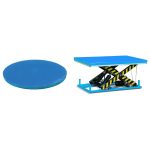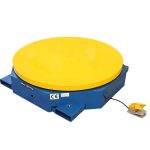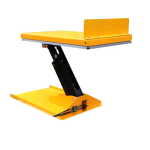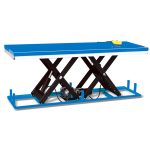



Fine metal dust creates challenges that are easy to underestimate when selecting material-handling equipment. A lift table may have sufficient load capacity and lifting height, but those specifications alone do not guarantee reliable operation in a dusty industrial environment.
When fine particles enter motors, switches, control boxes, limit switches, or electrical connections, they can cause premature wear, electrical faults, increased maintenance, and unexpected downtime. In some applications, the dust may also be conductive, corrosive, hazardous, or potentially explosive.
For this reason, selecting an electric lift table for a fine metal dust environment requires a more complete assessment of the application, operating frequency, electrical protection, control arrangement, maintenance access, and safety requirements.
This guide explains the most important factors to consider.
1. Start with the Actual Application
Before selecting a lift table, clearly define what the equipment will do during each operating cycle.
Important questions include:
- What material is being handled?
- What is the normal operating load?
- What is the maximum possible load?
- How frequently will the table be raised and lowered?
- Is the load centered or offset?
- Will the table support a container, fixture, scale, machine, or custom frame?
- Is the operation manual or integrated into an automated system?
- How close will the lift table be to the dust source?
For example, an industrial facility may use a lift table to position a collection container under a powder hopper. The table is lowered when the container is full, the container is replaced, and the table is raised back into position.
Although the load may be only around 100 kg, the lift table could complete this cycle every hour throughout the working day. In this situation, operating frequency, structural durability, and electrical protection may be more important than the load figure alone.
A light-duty lifting device may be able to raise the load initially, but repeated industrial operation in a dusty environment can significantly shorten its service life.
2. Identify the Dust Characteristics
Not all dust presents the same risk.
Before recommending a lift table configuration, the equipment supplier should understand:
- The type of material
- Approximate particle size
- Dust concentration
- Whether the dust is conductive
- Whether it is corrosive
- Whether it absorbs moisture
- Whether it is combustible
- Whether the area has a classified hazardous-zone requirement
- How the equipment is cleaned
Particle size is especially important. Very fine dust can enter small openings, settle on circuit boards, accumulate around electrical terminals, and interfere with moving components.
The supplier should not assume that a general industrial enclosure is suitable for every powder-handling environment. The required protection must be based on the actual material and working conditions.
3. Understand the Difference Between Dust Protection and Explosion Protection
Dust-protected equipment is not automatically explosion-proof.
This distinction is essential.
Dust protection is intended to reduce the entry of particles into electrical and mechanical components. Explosion protection is intended to prevent equipment from becoming an ignition source in a hazardous atmosphere.
An IP-rated motor, switch, or enclosure may provide useful protection against dust ingress, but an IP rating alone does not certify the equipment for use in an explosive dust atmosphere.
If combustible dust may be present, the user should complete a formal risk assessment and confirm:
- Whether the working area is classified
- Which standards apply in the destination country
- Whether certified explosion-proof components are required
- The required temperature class
- The applicable dust group and protection method
- Whether the complete machine, rather than individual components, requires certification
A supplier should clearly state whether a proposed lift table is dust-protected, explosion-proof certified, or neither. These terms should never be used interchangeably.
4. Select the Right Load Capacity
A common mistake is selecting a lift table with a rated capacity that is only slightly higher than the normal load.
For industrial use, the selection should also consider:
- Repeated operating cycles
- Uneven loading
- Dynamic forces during starting and stopping
- The weight of containers, fixtures, scales, and mounting frames
- Possible future process changes
- Long-term structural fatigue
- The required safety margin
A 100 kg working load does not always mean that a 100 kg or 150 kg lift table is the best choice.
For a frequent-duty industrial application, a 300 kg lift table may provide a more suitable margin. The higher capacity can reduce the percentage of maximum load used during each cycle and provide a more robust structure than a light-duty lifting system.
However, a larger capacity should not be selected blindly. The complete application must still be reviewed, including platform dimensions, load position, lifting frequency, actuator duty cycle, and mounting arrangement.
5. Evaluate the Electrical Protection
Electrical components are often the most vulnerable parts of an electric lift table in a fine-dust environment.
Depending on the application, a dust-protected configuration may include:
- An IP-rated motor
- Dust-protected push buttons
- Protected limit switches
- Sealed cable entries
- A dust-protected control enclosure
- Protected electrical connectors
- An external control box
- A filtration or ventilation system
- Easily replaceable filter elements
- Appropriate cable protection
IP65 components may be considered for applications requiring a higher level of dust protection, but the complete installation must be evaluated. Installing one IP65 component does not make the entire lift table IP65.
The protection level of the complete system depends on the motor, controls, switches, enclosures, cable glands, connectors, wiring arrangement, and installation quality.
6. Consider an Externally Mounted Control Box
Moving the main control box away from the immediate dust source can improve protection and simplify maintenance.
An externally mounted control box may offer several advantages:
- Reduced direct exposure to falling powder
- Easier inspection of electrical components
- Easier filter replacement
- Better access for maintenance
- Less dust accumulation inside the lift-table structure
- Greater flexibility in positioning sensitive electronics
The required cable length between the lift table and the control box should be confirmed before production.
The installation location also matters. The control box should not simply be moved from one dusty location to another. It should be positioned where it is protected, accessible, and compatible with the customer’s operating procedure.
7. Review the Filtration System Carefully
A filtered control enclosure can provide additional protection for electrical equipment, but filtration claims should be clearly defined.
When reviewing a filtration system, ask:
- What is the filter’s rated filtration accuracy?
- Is the rating nominal or absolute?
- What particle size was used for testing?
- What filtration efficiency is achieved?
- Is the enclosure positively pressurized?
- How often must the filter be inspected or replaced?
- What happens when the filter becomes blocked?
- Can replacement filters be sourced locally?
- Does the filtration system affect enclosure temperature?
A filtration rating should not be confused with the IP rating of an enclosure.
The filter must also be suitable for the actual dust particle size. For example, a filter intended to protect equipment from relatively large particles may not provide the same performance against much finer powder.
Clear technical data is more valuable than broad claims such as “completely dust-proof.”
8. Choose the Most Suitable Control Method
Electric lift tables can be operated using:
- Hand-held push-button controls
- Fixed push-button stations
- Foot controls
- Remote controls
- External control-system signals
- Automated sensors or process interlocks
In dusty environments, the control device should have an appropriate level of protection.
A foot control can keep the operator’s hands free, but its location may expose it to powder falling on the floor. A hand-held control may be easier to position away from the dust source, but the operator must be able to use it safely while observing the load.
The best control method depends on the working process, operator position, housekeeping conditions, and risk assessment.
The control logic should also be clarified. Some applications need only manual raising and lowering, while others require integration with a weighing system, production line, sensor, or programmable controller.
9. Confirm the Required Lifting Range
The minimum and maximum platform heights must match the process.
Key dimensions include:
- Lowered height
- Raised height
- Vertical stroke
- Platform size
- Available installation space
- Clearance around the machine
- Container height
- Hopper discharge height
- Space required to remove the container
A lower minimum height can make container changes easier and improve compatibility with existing equipment.
The supplier should also confirm the expected lifting time. A lift that moves too slowly may reduce production efficiency, while unnecessary speed may create stability or safety concerns.
10. Decide Between a Standard Platform and a Custom Interface
Some users do not need the standard lift-table platform because they already have a scale, support frame, fixture, or machine base.
In this case, the lift table may require a customized mounting interface.
Before removing or modifying the standard platform, confirm:
- The dimensions of the customer’s existing structure
- The mounting-hole pattern
- The total weight of the attached equipment
- The center of gravity
- The load distribution
- The required stiffness
- The weighing accuracy, if a scale is installed
- Whether vibration affects the measurement
- How the upper structure will be secured
Drawings and dimensional sketches are extremely helpful.
A custom interface should be designed as part of the complete lifting system. It should not be treated as a simple platform removal without reviewing stability and structural loading.
11. Check the Power Supply
Power requirements vary by country and site.
Before production, confirm:
- Voltage
- Frequency
- Single-phase or three-phase supply
- Plug and connector requirements
- Control voltage
- Motor voltage
- Transformer requirements
- Local electrical standards
For example, a North American industrial facility may require single-phase 110V or 120V power at 60Hz.
If the selected motor or control system uses a different voltage, a suitable transformer may be required. The transformer and its enclosure should also be considered in the dust-protection strategy.
12. Review Operating Frequency and Duty Cycle
The number of lifting cycles can significantly affect equipment life.
“Occasional use” and “one cycle every hour” are not the same, even when the load is identical.
The supplier should confirm:
- Cycles per hour
- Operating hours per day
- Working days per week
- Travel distance per cycle
- Time between cycles
- Motor duty rating
- Expected service life
- Lubrication intervals
- Inspection requirements
- Replacement-part availability
This information helps determine whether the actuator, motor, transmission, and electrical system are suitable for the required workload.
13. Plan for Cleaning and Maintenance
Dust protection reduces contamination, but it does not eliminate the need for maintenance.
A practical design should allow operators to:
- Inspect the actuator and moving components
- Clean exposed surfaces
- Check cable condition
- Inspect seals and cable glands
- Replace filters
- Test limit switches
- Access the control box
- Lubricate required points
- Remove accumulated powder safely
The cleaning method must also be considered.
Compressed air may spread hazardous dust into the surrounding area or force particles deeper into equipment. Cleaning procedures should follow the facility’s safety rules and the material supplier’s handling guidance.
14. Request Clear Technical Documentation
Before approving a customized lift table, request documentation covering:
- General arrangement drawing
- Platform and mounting dimensions
- Electrical specification
- Motor and actuator information
- Control method
- Protection ratings
- Filter specifications
- Wiring diagram
- Operating instructions
- Maintenance requirements
- Safety warnings
- Warranty conditions
- Spare-parts recommendations
- Applicable certifications
The quotation should clearly distinguish between standard features, optional upgrades, and application-specific modifications.
It should also state any important limitations, including whether the equipment is not explosion-proof certified.
Electric Lift Table Selection Checklist
Before ordering an electric lift table for a fine metal dust environment, confirm the following:
- Normal and maximum load
- Load dimensions and center of gravity
- Required minimum and maximum height
- Platform size or custom mounting interface
- Dust material and particle size
- Conductive, corrosive, or combustible properties
- Explosion-protection requirements
- Operating cycles per hour and per day
- Voltage and frequency
- Hand, foot, remote, or automated control
- Motor and electrical enclosure protection
- Control-box location
- Cable length
- Filtration specifications
- Cleaning and maintenance procedure
- Required drawings and certifications
Conclusion
Selecting an electric lift table for a fine metal dust environment involves much more than checking load capacity and lifting height.
A reliable solution must consider the dust characteristics, operating frequency, electrical protection, control arrangement, mounting interface, maintenance access, and applicable safety requirements.
In many cases, a standard lift table can be adapted using protected electrical components, an externally mounted control box, filtration, customized controls, and a purpose-designed platform interface. However, the final configuration should always be based on a detailed review of the actual application.
Most importantly, dust-protected equipment should never be represented as explosion-proof unless it has the required certification.
At i-LIFT, we work with industrial customers to evaluate their lifting applications and develop electric lift-table configurations for demanding working environments. Contact our team with your load, lifting range, operating frequency, power supply, platform dimensions, and environmental conditions so that we can recommend a suitable solution.
Related Products
 Dust-Protected vs. Explosion-Proof Equipment: What Is the Difference?
- HRL Rotating Lift Table vs. ERP2000 Stretch Wrap Machine: How to Choose the Right Solution for Your Pallet Handling Application
- How to Move a 10-Ton Heavy Load Safely: Choosing the Right Rotating Roller Machine Skates
- Custom Stationary Lift Table: Key Factors You Must Consider Before Ordering
- Does a 300kg Application Really Need a 1000kg Rotating Lift Table?
- ERP2000 Automatic Stretch Wrap Machine Electric film winding machine
- ALT750 Tilter Table: The Smart Solution for Precision Material Handling
- HW2000D large platform lift table
- A Complete Guide to Using Container Jacks: Tools, Process, Safety, and Applications
- How a Pallet Tilter Reduces Injuries (MSDs) in Warehouses