


When buyers choose a stationary lift table, one of the most common questions is:
Does the lift table need to be installed in a pit?
The answer is: not always.
A stationary scissor lift table can usually be installed in two ways: pit installation or surface installation. Both methods are common, but they are suitable for different working conditions. The right choice depends on your site layout, loading method, civil construction conditions, and daily operation needs.
In this article, we will explain the differences between pit-mounted and surface installation, including their advantages, typical applications, and how to choose the best option for your project.
What Is a Stationary Lift Table?
A stationary lift table, also called a fixed scissor lift table, is a material handling device used to raise, lower, and position goods at different working heights.
It is widely used in:
- Warehouses
- Workshops
- Production lines
- Logistics centers
- Loading and unloading areas
- Maintenance areas
- Material handling systems
Unlike mobile lift tables, stationary lift tables are fixed in one position and are usually used for regular lifting operations at a specific workstation or loading point.
Does a Stationary Lift Table Need a Pit?
A stationary lift table can be installed in a pit, but it does not always require a pit.
There are two main installation methods:
- Pit installation
The lift table is installed inside a prepared floor pit. When fully lowered, the platform can be almost level with the floor. - Surface installation
The lift table is installed directly on the existing floor without digging a pit. Goods can be loaded by forklift or with the help of a steel ramp.
Each installation method has its own benefits.
1. Pit Installation
Pit installation means that a pit is prepared in the floor before the lift table is installed. The equipment is placed inside the pit, so when the platform is fully lowered, the platform surface is flush or nearly flush with the surrounding floor.
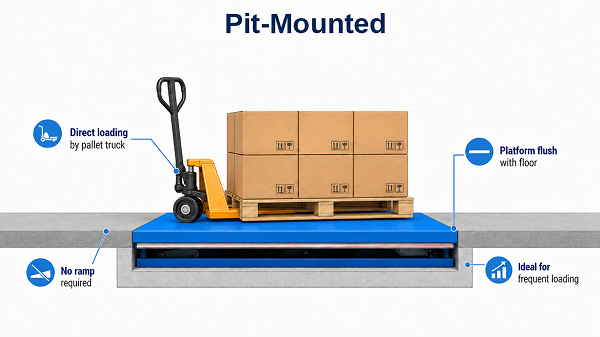
This installation method is very convenient for loading and unloading. A pallet truck, trolley, hand cart, or worker can move goods directly onto the platform without using a ramp.
Advantages of Pit Installation
The biggest advantage of pit installation is easy access.
When the lift table is lowered, the platform is at floor level. This means goods can be pushed directly onto the platform. It is especially useful when the customer uses pallet trucks, hand carts, or trolleys frequently.
Pi installation also saves working space because no ramp is required. The working area remains clean and smooth, which is ideal for busy warehouses or production areas.
Main advantages include:
- Platform can be flush with the floor
- Easy loading by pallet truck, trolley, or hand cart
- No ramp required
- Better for frequent loading and unloading
- Cleaner and more professional installation
- Suitable for long-term fixed working positions
Typical Applications of Pit-Mounted Lift Tables
Pit installation is commonly used in places where loading is frequent and smooth movement is important.
It is suitable for:
- Warehouse loading points
- Production line height adjustment
- Material transfer between different working levels
- Packing and assembly lines
- Logistics handling areas
- Workstations where pallet trucks are used often
If the customer wants the most convenient loading method and the site allows civil construction, pit installation is usually the best choice.
Things to Consider Before Pit Installation
Although pit installation is convenient for daily use, it requires more preparation before installation.
The customer should confirm:
- Pit size
- Pit depth
- Floor bearing capacity
- Drainage conditions
- Power cable layout
- Maintenance access
- Safety clearance around the platform
For pit installation, the supplier should provide a pit drawing before delivery so the customer can prepare the site correctly.
2. Surface Installation
Surface installation means that the stationary lift table is installed directly on the existing floor. No pit is required.
This is a simpler installation method. It is suitable for customers who cannot dig a pit or want to reduce civil construction work.
However, because the lift table has a certain lowered height, the platform is still higher than the ground when fully lowered. Therefore, goods need to be loaded in another way.
There are two common loading methods for surface-mounted lift tables:
- Loading with a ramp
- Loading with a forklift
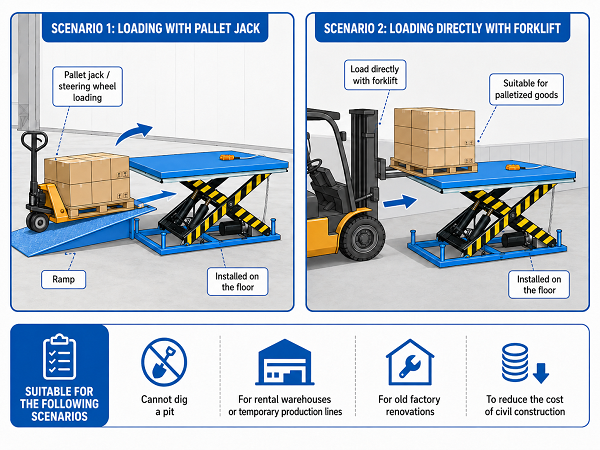
Surface Installation with Ramp
For surface installation, a steel ramp can be placed in front of the lift table. This allows pallet trucks, trolleys, or hand carts to move goods onto the platform.
This solution is useful when the customer cannot make a pit but still needs to load goods manually or with a pallet truck.
Advantages of Surface Installation with Ramp
This method avoids civil construction and keeps installation simple.
Main advantages include:
- No pit required
- Faster installation
- Lower civil construction cost
- Suitable for existing factories
- Suitable for rented workshops
- Pallet trucks and trolleys can still be used with a ramp
Things to Consider When Using a Ramp
The ramp needs enough space in front of the lift table. If the site is narrow, the ramp length and slope should be carefully checked.
The customer should confirm:
- Available floor space
- Ramp length
- Ramp slope
- Loading direction
- Pallet truck size
- Load weight
- Platform size
This option is suitable when the customer wants easy installation but still needs pallet truck loading.
Surface Installation with Forklift Loading
Another common method is loading goods directly by forklift.
In this case, the lift table is installed on the floor, and the forklift places palletized goods directly onto the platform.
This method is very suitable for warehouses and factories where forklifts are already used for daily material handling.
Advantages of Forklift Loading
Forklift loading is simple and efficient for palletized goods. It does not require a ramp, and it does not require a pit.
Main advantages include:
- No pit required
- No ramp required
- Suitable for palletized goods
- Good for heavy-duty loading
- Faster installation
- Suitable for warehouse and logistics operations
Things to Consider for Forklift Loading
When using a forklift to load goods onto the platform, the platform size and loading direction must be suitable.
The customer should confirm:
- Forklift access space
- Pallet size
- Load capacity
- Platform dimensions
- Loading direction
- Floor condition
- Safety clearance around the lift table
This method is recommended when the customer mainly handles palletized goods and already has forklift equipment on site.
Pit-Mounted vs Surface-Mounted
Here is a simple comparison:
| Item | Pit-Mounted | Surface-Mounted |
|---|---|---|
| Pit required | Yes | No |
| Civil construction | Required | Not required or minimal |
| Platform position when lowered | Flush or nearly flush with floor | Higher than floor |
| Loading method | Direct loading | Ramp or forklift loading |
| Ramp required | No | Optional |
| Forklift loading | Available | Available |
| Installation time | Longer | Faster |
| Daily operation convenience | Very convenient | Depends on loading method |
| Best for | Frequent loading, pallet truck use, fixed production areas | Rented factories, retrofit projects, temporary work areas |
How to Choose the Right Installation Method
The best installation method depends on the customer’s actual working conditions.
Choose Pit Installation If:
Pit installation is recommended if the customer wants smooth, floor-level loading.
It is a good choice when:
- The platform needs to be flush with the floor
- Pallet trucks or trolleys are used frequently
- Goods need to be moved directly onto the platform
- The equipment will be used in a fixed position for a long time
- Civil construction is allowed
- The customer wants a clean and efficient working area
This is often the most convenient solution for long-term industrial use.
Choose Surface Installation If:
Surface installation is recommended when the customer wants a simpler and faster installation.
It is a good choice when:
- The site cannot make a pit
- The workshop is rented
- The project is temporary
- The customer wants to reduce civil construction cost
- Goods can be loaded by forklift
- A ramp can be used for pallet truck loading
- The equipment may need to be relocated in the future
This solution is practical for existing factories, warehouse retrofits, and temporary production areas.
What Information Should Buyers Provide Before Ordering?
To recommend the correct stationary lift table and installation method, the supplier usually needs the following information:
- Required load capacity
- Platform size
- Maximum lifting height
- Lowered height requirement
- Installation method: pit-mounted or surface-mounted
- Loading method: pallet truck, trolley, forklift, or manual loading
- Pallet or goods dimensions
- Power supply
- Indoor or outdoor use
- Site photos or layout drawing
- Any special safety requirements
The more information the buyer provides, the more accurate the recommendation will be.
Conclusion
A stationary lift table does not always need a pit. It can be installed either in a pit or directly on the floor.
Pit installation is ideal when the customer wants the platform to be flush with the floor and needs easy loading by pallet truck, trolley, or hand cart.
Surface installation is a good choice when the customer cannot dig a pit, wants faster installation, or plans to load goods by forklift or with a ramp.
Both installation methods are widely used in industrial material handling. The best solution depends on the customer’s site conditions, loading method, and daily operation requirements.
Before choosing a model, buyers should confirm the load capacity, platform size, lifting height, installation method, loading method, and site layout. With this information, the supplier can recommend the most suitable stationary lift table solution.
Related Products
 When Do You Need a U-Shape Low Profile Stationary Lift Table?
- Stop Bending Over to Handle Pallet Loads A Smarter Way to Work at Waist Height
- Where Can a Pallet Turntable Be Used in Material Handling?
- How To Maintain Your Stationary Lift Table
- HRL1000 HRL2000 Full Electric Rotating Lift Table 1000kg 2000kg
- YSG vs. YSS Stainless Steel Scissor Lift Cart: Which Stainless Steel Lift Table Is Better for Your Application?
- Why Hydraulic Toe Jacks Have Two Capacities (Toe vs Head)
- Trailer Trestle vs. Trailer Stabilizer Jack: How to Choose the Safest Support for Semi-Trailers & Container Loading
- 5 Common Mistakes Buyers Make When Selecting Rotating Roller Machine Skates
- Factors to Consider When Selecting a Work Positioner